
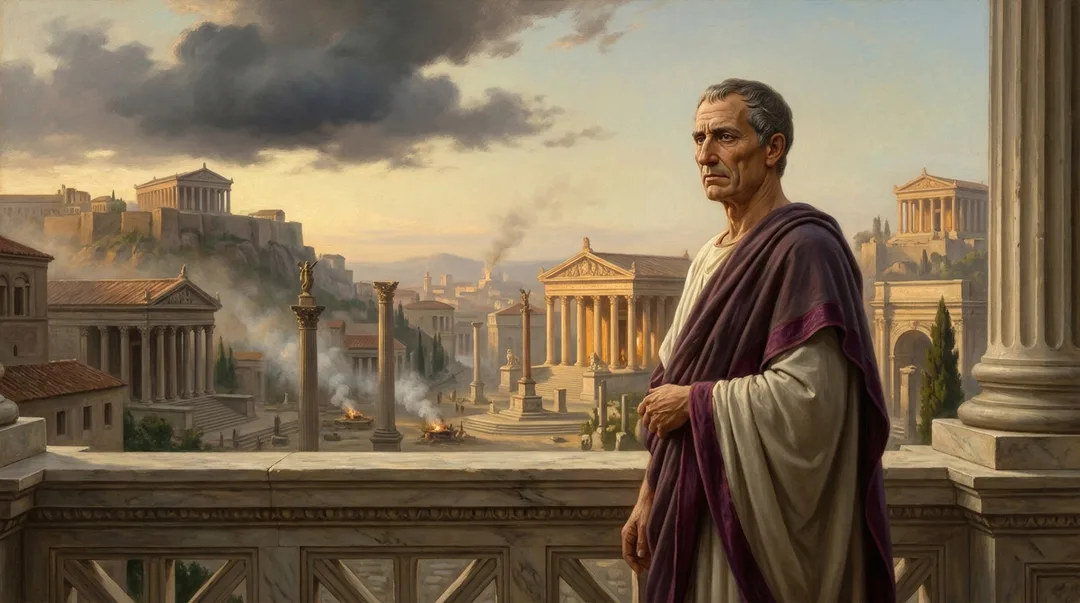

Ancient Era · 3000 BC – 500 AD

Ancient History Scenarios

Three thousand years from the first civilizations to the fall of Rome. Play the moments that shaped the classical world — the conspiracy that killed Caesar, the wars that broke Carthage, the day Rome fell.

Why the Ancient World, Played

The classical world is the foundation Western civilization was built on — but most of us learn it as a list of dates and famous names. Caesar crossed the Rubicon. Hannibal fought elephants. Sparta held the pass at Thermopylae. The actual lived experience of these moments — the information the historical actors had, the decisions they faced, the constraints under which they had to think — gets lost in the textbook treatment.

HistoryForge scenarios drop you into the specific moments where one decision tipped the balance. Not lectures. Not lists of dates. The exact crossroads a real person stood at, with the information they actually had.

The Ancient Scenarios Available Now

44 BC — The Ides of March. You are Julius Caesar. Dictator Perpetuo. Conqueror of Gaul. Your wife had a nightmare. The seer Spurinna told you to beware this day. Sixty senators are sharpening daggers in the dark — including your closest friend. Three decisions. Three endings. The most over-documented political assassination in ancient history, replayable.

What's Coming

Ancient scenarios in production include the Battle of Thermopylae (480 BC), the destruction of Carthage (146 BC), Spartacus's slave revolt (73-71 BC), the Battle of Cannae (216 BC), and the sack of Rome by the Visigoths (410 AD).

Questions

What counts as 'ancient' in HistoryForge?+

Roughly 3000 BC to 500 AD — from the first civilizations in Mesopotamia and Egypt through the fall of the Western Roman Empire. The era covers the Bronze Age collapse, classical Greece, the Persian Empire, the Roman Republic, and Imperial Rome. The current available scenario covers one of the era's defining moments: the assassination of Julius Caesar in 44 BC. More ancient scenarios are in production — including the Battle of Thermopylae, the destruction of Carthage, and the fall of the Western Roman Empire.

Why start with Caesar?+

Because the Ides of March is the most over-documented political assassination in ancient history. We have Plutarch, Suetonius, Cassius Dio, Cicero's letters, and Shakespeare working from a common Latin tradition. We know the dream, the omen, the seer's warning, the note Caesar didn't read. It is the cleanest case study in the ancient record for what happens when a single decision changes the course of an entire civilization.

How long does each scenario take?+

Six to eight minutes. Three rounds of decisions plus the consequence sequences and outcome reveal. Each ends with a 'what actually happened' historical deep-dive grounded in primary sources.