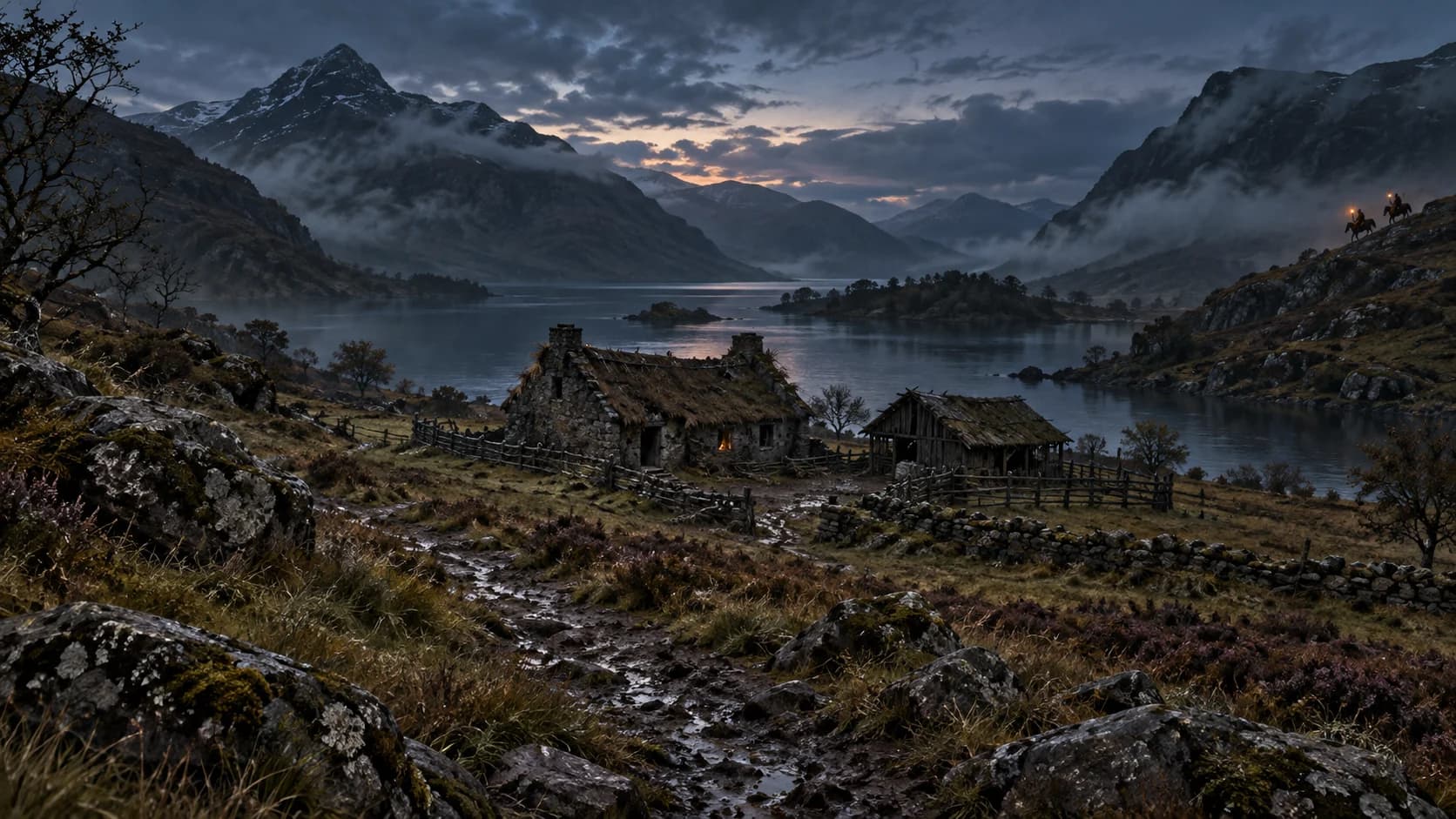
The Lindisfarne Raid: A Complete Overview
On the morning of June 8, 793 AD, a small fleet of Norse longships beached on the eastern shore of Lindisfarne, a tidal island off the northeast coast of England. Within hours, they had killed monks, looted the monastery's treasury, taken captives, and sailed away with as much wealth as their ships could carry. The raid itself was over before noon. The shock it sent through Christian Europe lasted three centuries.
Historians traditionally mark this single morning as the start of the Viking Age — the 300-year period from 793 to roughly 1066 during which Norse seafarers raided, traded, and settled across Europe, from Constantinople to Greenland.
Why Lindisfarne Shocked Christendom
Across the Christian world, monasteries were understood to be under divine protection. The medieval framework was theological: a pagan army that attacked a church was supposed to be struck down by God. When the Norse burned Lindisfarne and sailed away rich and unpunished, that framework collapsed in a single morning.
Alcuin of York, the English scholar then serving at the court of Charlemagne, wrote a horrified letter: "Never before has such terror appeared in Britain as we have now suffered from a pagan race, nor was it thought that such an inroad from the sea could be made. Behold the church of St. Cuthbert, splattered with the blood of God's priests, despoiled of all its ornaments — a place more sacred than any in Britain — given as prey to pagan peoples."
The Anglo-Saxon Chronicle marked the year 793 with portents: dragons in the sky, whirlwinds, famine. The medieval mind was trying to find a cause big enough to match what had happened. The actual cause was simpler: a few hundred men in shallow-draft boats who didn't share Christian assumptions about which places were sacred.
Why the Norse Started Raiding
Historians debate the exact mix of causes, but several factors converged in the late 8th century:
- Shipbuilding revolution. The Norse had developed the longship — a fast, shallow-draft, ocean-capable vessel that could land directly on a beach. No port required. This was a strategic technology Christian Europe didn't possess.
- Population pressure. Scandinavian populations had been growing for several generations. Marginal land was filling up. Younger sons had limited inheritance prospects.
- Political consolidation. Local kings and chieftains were gaining power through raid-derived wealth. Successful raiding produced loyal warriors, who produced more successful raids — a positive feedback loop.
- Wealth gradient. Christian Europe had spent 200 years accumulating church treasure. Monasteries were lightly defended repositories of gold, silver, jeweled reliquaries, and illuminated manuscripts. From a Norse perspective, they were lightly guarded banks.
- Religious indifference. Norse cosmology had no problem with attacking Christian sites. Christian assumptions about "sacred ground" meant nothing to a Scandinavian raider.
The Real Tactics a Norse Jarl Used
Each of the following was a documented Norse tactic:
- Speed over slaughter. The most successful Viking raids hit before defenders could organize a response. Time on land was the enemy. A raid that lasted more than a few hours risked being trapped by a relieving force.
- Patrol ambushes. Norse scouts gathered intelligence on coastal patrols before striking. Eliminating responding forces extended raiding time and demoralized future defenders.
- Tribute extraction. Many raiders took payment to leave instead of fighting. Over the following centuries this became formalized as Danegeld — tribute systems through which English kings paid Viking war-bands tens of thousands of pounds of silver to make them go away. Anglo-Saxon coin hoards in Scandinavia attest to its scale.
- Captive-taking. Slaves were as valuable as gold. Dublin became one of medieval Europe's largest slave markets under Norse control. Captives — usually women and children, sometimes young men — were sold across the Norse trade network, reaching as far as the Byzantine Empire and the Islamic caliphates.
- Burning sites. Some raiders torched what they couldn't carry. The smoke was both a signal to other raiders and a message to defenders: your gods cannot protect you.
- Sailing decisions. The voyage home was as dangerous as the raid. Hugging coast, running before storms, beaching for a stand — each had real survival math.
What Survived the Raid
The most extraordinary survival from the Lindisfarne raid is the Lindisfarne Gospels — an illuminated manuscript created around 700 AD by Eadfrith, Bishop of Lindisfarne. It contains the four Gospels in Latin, decorated with intricate Celtic and Anglo-Saxon interlace patterns and full-page portraits of the evangelists. It is one of the greatest masterpieces of medieval art.
How exactly it survived isn't known — possibly hidden by monks during the raid, possibly taken inland during a later evacuation. It eventually traveled with the body of St. Cuthbert during the long monastic exodus from Lindisfarne, ending up at Durham Cathedral. Today it is held in the British Library.
Aftermath: What Lindisfarne Started
Lindisfarne wasn't the first Norse raid — there had been small-scale Scandinavian incursions along the English coast for decades. But 793 was the moment Christian Europe understood that something fundamental had changed.
Within a generation, Norse raids on the British Isles became routine. By the 830s, raiders were wintering in England rather than returning home — turning seasonal raids into permanent presence. By the 860s, the Great Heathen Army arrived: not a raid but an invasion. Within a decade, the Anglo-Saxon kingdoms of Northumbria, East Anglia, and Mercia had fallen to Norse rule. Only Wessex, under Alfred the Great, survived.
The Norse legacy on England is permanent: the legal term "law" itself is Norse, as are "sky," "skin," "egg," and thousands of other everyday words. Place names ending in -by (village), -thorpe (hamlet), or -kirk (church) mark the Danelaw boundaries. The English language as we speak it today is, in part, a product of the centuries that began with three or four longships on a Northumbrian beach.
Knowledge Check
What year is traditionally considered the start of the Viking Age?+
793 AD. The raid on Lindisfarne on June 8, 793 is traditionally marked as the beginning of the Viking Age, shocking Christian Europe and launching two centuries of Norse expansion across the seas.
What was 'Danegeld'?+
Tribute payments — silver paid by English kings to Viking raiders to leave English lands alone. The practice became formalized over the 9th-11th centuries; England paid out tens of thousands of pounds of silver over generations. It made some Viking war-bands extraordinarily wealthy.
What major Viking-controlled territory was created in England?+
The Danelaw. After centuries of raids and the eventual Great Heathen Army invasion of the 860s, large areas of northern and eastern England came under Norse rule and Norse law — a region known as the Danelaw. Place names ending in -by, -thorpe, and -kirk still mark its boundaries today.
Frequently Asked Questions
What happened at Lindisfarne in 793 AD?+
On June 8, 793, Norse raiders attacked the monastery of Lindisfarne on the northeast coast of England. They killed an unknown number of monks, looted the treasury, burned parts of the monastery, and sailed back to Scandinavia with treasure and captives. The Anglo-Saxon Chronicle recorded it as a uniquely shocking event — pagans attacking Christianity's most sacred ground without divine consequence. Historians traditionally mark it as the beginning of the Viking Age.
Why was the Lindisfarne raid such a big deal?+
It wasn't the scale — probably only three or four longships and a few hundred raiders. It was the symbolism. Monasteries were considered untouchable, protected by God. When the Norse burned Lindisfarne without divine consequence, it shattered the medieval understanding that Christian holy sites were immune to violence. Within two generations, Vikings were raiding from Spain to Russia. Within four, they ruled large parts of England, Ireland, and France.
Where was Lindisfarne?+
Lindisfarne — also called Holy Island — is a tidal island off the northeast coast of England in modern Northumberland, near the border with Scotland. The monastery was founded in 635 AD by St. Aidan, an Irish monk sent from Iona to Christianize the Anglo-Saxons. It became the spiritual heart of Northumbrian Christianity and the home of the cult of St. Cuthbert. The island is reachable by a tidal causeway that is submerged twice daily.
What did the Vikings take from Lindisfarne?+
Gold and silver liturgical objects (chalices, crosses, reliquaries), illuminated manuscripts, captives for the slave trade, and food/supplies. The monastery had accumulated wealth for over 150 years and was effectively undefended. Notably, the Lindisfarne Gospels — one of the greatest masterpieces of medieval art, created around 700 AD — survived the raid. The book is now in the British Library.
Did Vikings come back to Lindisfarne?+
Yes. Lindisfarne was raided multiple times over the following century. The monks eventually abandoned the island in 875 AD, taking the body of St. Cuthbert and other treasures inland. They wandered for seven years before settling at Chester-le-Street, and eventually at Durham — where Cuthbert's shrine still stands in Durham Cathedral.
What tactics did Viking raiders actually use?+
Each of these was a documented Norse raiding tactic: speed-strike before reinforcements arrive (the primary tactic of Viking raids for the next 200 years), ambushing patrols, demanding tribute (the precursor to Danegeld, the formalized tribute system England later paid), taking captives for the Dublin slave markets, hugging coasts to avoid storms on the return voyage, and beaching ships for a stand. Norse warriors were sophisticated tacticians, and these were the choices actually open to them.
When did the Viking Age end?+
Traditionally dated to 1066, with the Battle of Stamford Bridge — where the Anglo-Saxon king Harold Godwinson defeated the last great Norse invasion under Harald Hardrada. Three weeks later Harold himself was killed at Hastings by William the Conqueror — himself a Norman, descended from Vikings who had settled in Normandy. The Viking Age ended; the Viking legacy continued.
Sources
- ·The Anglo-Saxon Chronicle (c. 890 AD)
- ·Neil Price, Children of Ash and Elm: A History of the Vikings (2020)
- ·Anders Winroth, The Age of the Vikings (2014)
- ·Alcuin of York, letters to Charlemagne (793-796 AD)