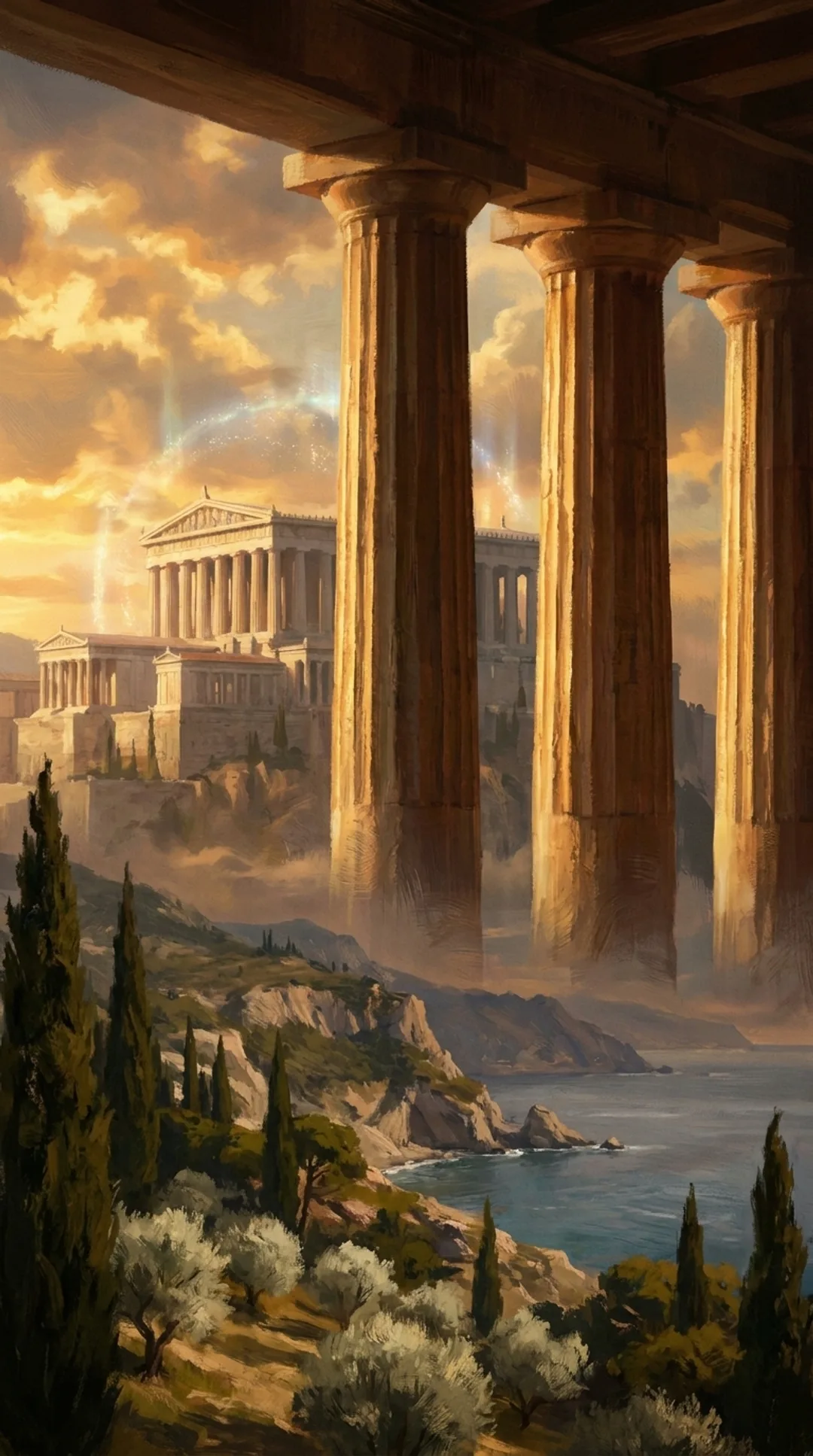
The Twelve Olympians
The Twelve Olympians are the principal gods of Greek mythology who lived on Mount Olympus, the highest peak in Greece. They were not a fixed pantheon — different Greek city-states emphasized different gods, and the list of twelve shifted over the centuries. The earliest list usually counted Hestia, goddess of the hearth, as the twelfth; by late antiquity she was replaced by Dionysus in most accounts. The Greeks worshipped at least a hundred named gods plus thousands of local heroes, nymphs, river-spirits, and demigods. Mythology was not a unified theology — it was a set of conflicting regional stories preserved by poets who disagreed with each other.
The full twelve plus Hades, in order of usual prominence: Zeus (sky-father, king of the gods), Hera (queen, marriage), Poseidon (sea, earthquakes), Demeter (harvest, mothers), Athena (wisdom, strategic warfare, Athens), Apollo (sun, music, prophecy, medicine), Artemis (hunt, moon, wildness), Ares (war as actual violence), Aphrodite (beauty, love, desire), Hephaestus (forge, craftsmanship), Hermes (messengers, travelers, thieves, souls), Dionysus (wine, ecstasy, theater, transformation). Plus Hades, residing below, lord of the dead and the wealth of the earth.
Why the Pantheon Still Resonates
The Greek gods are not gods of a coherent moral system. They are not, in most stories, kind. They fight each other, sleep with each other's spouses, take revenge on mortals over trivial slights, and break their own laws constantly. This is precisely why they have lasted three thousand years in the Western imagination — the pantheon is human personality patterns rendered at superhuman scale. Zeus is the man who has the most power in the room and is least equipped to handle it. Hera is the wife who has been wronged so many times she has become her own enforcement mechanism. Hephaestus is the genius who is also the outsider, the one everyone admires for what he makes and avoids personally.
This is why a quiz on the Olympians works as a personality test. The archetypes are deep enough that almost anyone takes a few questions and recognizes themselves in one of them. The trick is that the recognition tells you something true about yourself — usually something you already knew but hadn't articulated.
How the Quiz Is Built
Each of the ten questions is drawn from an actual moment in Greek mythology — the Judgment of Paris, the descent into the underworld, the war among the gods, the rivalries among the twelve. Each answer assigns points across multiple Olympians (no answer maps to only one god, because no real personality maps to only one archetype). After ten questions, the god you score highest with is your result.
Result text doesn't just say "you're Apollo because you're creative." It explains the god's actual mythology, cult center, divine attributes, and the psychological pattern they represent — including the shadow side, because every Olympian has one. If the result feels uncomfortably accurate, that's the design.