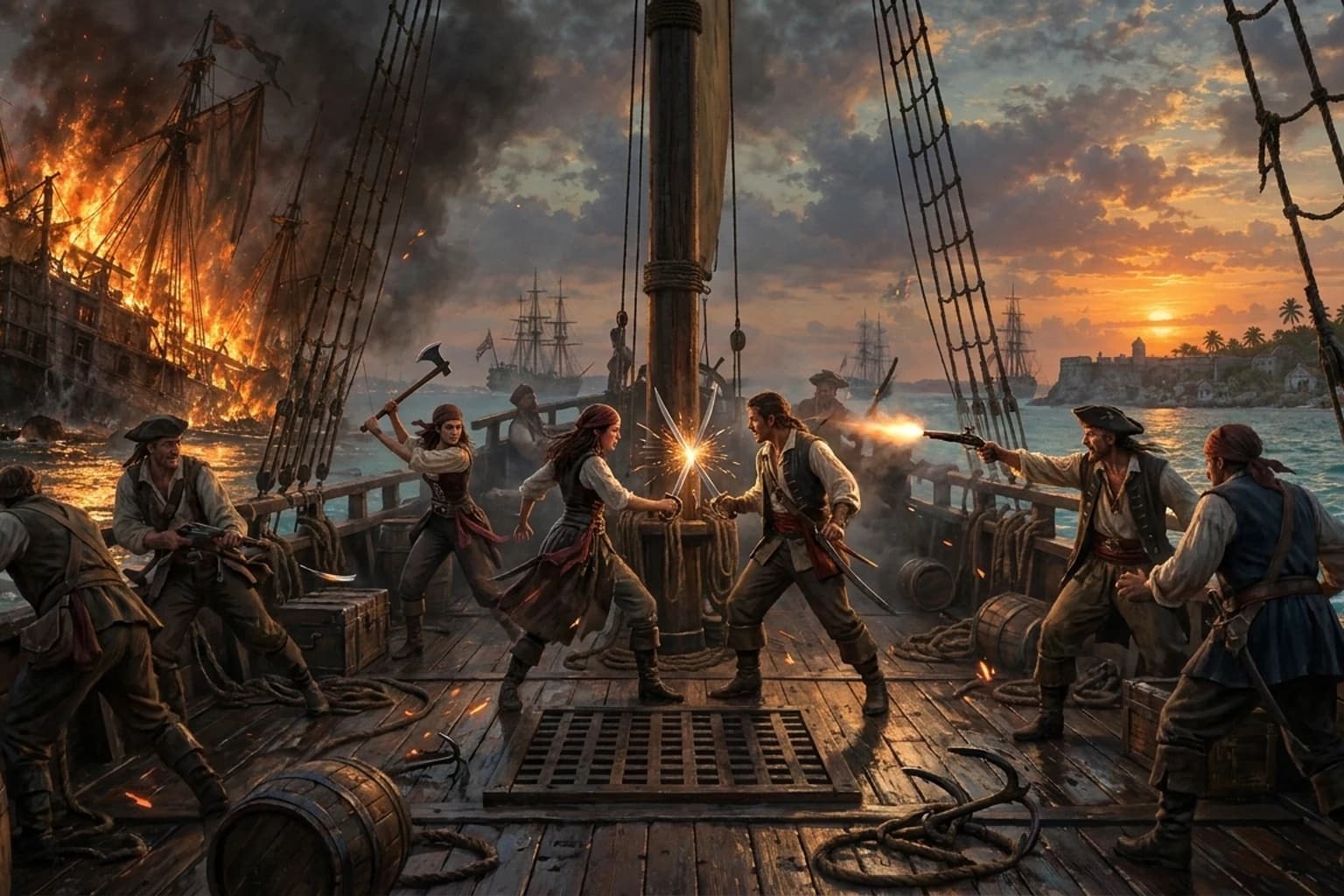
When the Golden Age Was
The phrase is not contemporary. It was coined by the American historian John Fiske in 1897, who wrote that the business of piracy had never thriven so greatly as in the seventeenth century and the early eighteenth, and put its golden age at roughly 1650 to 1720.
Historians normally split it into three. The buccaneering era of about 1650 to 1680, when Anglo-French crews out of Jamaica and Tortuga preyed on Spanish shipping. The Pirate Round of the 1690s, long voyages from the Americas to the Indian Ocean and the Red Sea. And the short, violent final phase of about 1715 to 1726, based in the Caribbean and on the American seaboard. That last phase is the one everybody pictures, and it lasted about a decade.
Why It Happened When It Did
The Treaty of Utrecht ended the War of the Spanish Succession in 1713 and created the conditions almost overnight. Privateering commissions became worthless. Navies demobilised thousands of trained, armed seamen into a labour market that was about to contract: after a brief restocking boom, trade slumped from late 1715 and stayed down into the 1730s. Merchant wages sat at 24 to 25 shillings a month for most of that period, and shipboard discipline, as Marcus Rediker documents, grew harsher rather than softer.
Then came the accelerant. On 31 July 1715 a hurricane wrecked the Spanish treasure fleet off the Florida coast. The Spanish salvaged roughly 350,000 pieces of eight into a storehouse on the beach, guarded by about sixty soldiers. Henry Jennings turned up with two ships and three sloops, landed 300 men, and took all of it, relieving a Spanish vessel of another 60,000 on the way back. Jamaica declined to shelter him. He went to Nassau instead.
The Crown itself dated the emergency from that moment. When the pardon proclamation was issued two years later, the piracies it addressed were those committed since 24 June 1715.
Why Nassau
The harbour was the point. Sheltered behind Hog Island, with two entrances, and shallow enough that heavy men-of-war could not comfortably come in after you, while the shallow-draft sloops pirates preferred could. It was good ground for careening, which is the unglamorous but essential business of beaching a ship to scrape her hull. And it sat directly on the Florida Straits, which is where the shipping was.
It was also effectively ungoverned. The Bahamas were a proprietary colony granted in 1670 and then largely abandoned. Nassau had been attacked and wrecked some thirty-four times by the French and Spanish during the war. The Bahamas National Archives records a ruined fort, general lawlessness, and a local government that let pirates use the harbour in exchange for a share of the takings.
The population is documented rather than guessed at, because worried officials kept counting it. In July 1717 Captain Matthew Musson reported five crews based there, 360 men between them. In February 1718 Captain Vincent Pearse of HMS Phoenix put it at about 500, describing them as young, resolute and wicked fellows. By July 1718 roughly a thousand pirates made up the large majority of everyone on the island.
The Republic That Was Not Called That
No contemporary source calls Nassau a republic. The royal proclamation of 1717 calls Providence the usual retreat and general receptacle for pirates. The closest contemporary language is a royal official in 1718 complaining about a nest of pirates in the Bahamas who already esteem themselves a community, and to have one common interest. Community, not republic. The pirates themselves used the name Flying Gang. The phrase Republic of Pirates entered general use through the title of Colin Woodard's 2007 book.
The distinction matters because the romantic version imagines a governed place. Contemporary descriptions of the town describe the opposite: the strongest man carries the day, and every man doing only what is right in his own eyes. One pirate demanded twenty shillings from a ship's captain and threatened to whip him. Benjamin Hornigold announced that all pirates were under his protection and threatened to burn a settler's house down.
The genuinely remarkable democratic machinery was real, but it operated aboard ships rather than over the town, which is a different and more interesting claim.
What the King's Pardon Actually Said
This is the most misunderstood document of the period, and the text is public. The proclamation was given at Hampton Court on 5 September 1717 and printed in The London Gazette a fortnight later. Its terms were narrow in three ways that decided everything that followed.
It was closed at both ends. A pirate had to surrender by 5 September 1718. But the pardon only covered piracies committed before 5 January 1718. That gap is the whole problem: a man could surrender comfortably inside the deadline and still hang for anything he had done in the intervening eight months.
It pardoned piracy, and said nothing else. As printed, the text addresses piracy only. It does not promise a pardoned man that he keeps his plunder, and it offers him no commission, no employment and no land afterwards.
It sent him back to what he had fled. A pardoned pirate's realistic prospect was the merchant service at 24 to 25 shillings a month under a captain who could flog him. Rediker's judgement is that the pardons largely failed for exactly this reason: the date limits looked like official trickery, and abiding by the terms meant returning to the dismal conditions the men had escaped.
The same issue of the Gazette printed the alternative. A bounty schedule of £100 for a delivered pirate captain down to £20 for a private man, £200 for a crewman who handed over his own commander, and a list of fourteen named King's ships ordered to combine against the pirates.
Vane's Letter, and What the Pirates Understood
Woodes Rogers, a Bristol privateer who had already sailed around the world and rescued Alexander Selkirk from his island, arrived in late July 1718 as the first Royal Governor of the Bahamas. Around two hundred pirates formed up in two lines and fired muskets in salute as he landed, and the pardon was read out in the ruins of Fort Nassau.
Charles Vane did not join them. He wrote to Rogers instead, and the letter is the single best evidence of what these men thought a pardon was worth. He was willing to accept it, he said, on terms: that Rogers would suffer them to dispose of all the goods now in their possession, and to act as they thought fit with everything belonging to them. If not, they were obliged to stand on their defence. He awaited a speedy answer.
In other words, the pirates had read the document carefully enough to notice that it said nothing about their property, and Vane tried to negotiate that point in writing with the governor. Rogers sent two sloops after him. Vane cut his cable, set fire to a captured French prize in the middle of the harbour, and escaped through the narrow eastern passage with his guns firing and his black flag up.
Recidivism was the rule. Vane was pardoned in February 1718 and back at sea by 21 March. Blackbeard took a pardon from the governor of North Carolina in June 1718 and was dead in a boarding action by November. Stede Bonnet, Edward England and John Rackham all went back too.
Rogers answered with a gallows. He sent out a sloop under Hornigold, by then a pardoned man hunting his former colleagues, and reported to London that thirteen pirates had been taken, three of whom died of their wounds. A court of seven commissioners, the minimum the law allowed, sat in the guard room at Nassau that December, and the survivors were publicly hanged. The count usually given is eight, which comes from later historians rather than from Rogers' own dispatch; what the dispatch does record is that he reprieved one man, George Rounsivell, beneath the gallows, on the grounds that he was the son of loyal and good parents in Dorsetshire.
He also repaired the fort, raised a redoubt of eight guns covering the channel Vane had used, and organised the population into militia companies he privately admitted he did not trust. It worked. New Providence was never used as a pirate base again.
The Numbers Behind the Legend
Rediker's reconstruction, built from crew-size records rather than a census, remains the standard. Around 4,500 to 5,500 people went, in their own phrase, upon the account across the whole period. Active at any one time: 1,800 to 2,400 in 1716 to 1718, then 1,500 to 2,000, then a collapse to fewer than 200 by 1726.
Two details put Nassau in perspective. First, roughly 3,600 pirates, more than seventy percent of everyone active in the decade, trace their descent through just two lines, and one of them begins at the Bahamas rendezvous. Nassau is genealogically upstream of most of the Golden Age. Second, the reason prizes usually surrendered without a fight was arithmetic: a pirate crew averaged around eighty men, while a comparable merchantman carried thirteen to seventeen.
Myth and Record
Walking the plank
No documented case in the Golden Age. The phrase does exist in the period, but not as piracy: Francis Grose's slang dictionary of 1788 defines it as a way of disposing of people during a mutiny aboard ship. The pirate version is a nineteenth-century picture-book invention, running through Howard Pyle's illustrations to Peter Pan, and every alleged real incident postdates the Golden Age by decades.
Marooning, by contrast, is real and written into the articles: a man who cheated his company could be put ashore on a deserted island with a gun, a little shot, a bottle of water and a bottle of powder, to subsist with or starve.
Buried treasure
Pirates spent their money, quickly, and most plunder was cargo and ship's stores rather than coin. There is essentially one real case: William Kidd buried gold and silver on Gardiner's Island in 1699. We know precisely because the authorities dug it up within weeks and inventoried it as trial evidence, at 1,111 ounces of gold and 2,353 ounces of silver. No map was involved, and Kidd hanged anyway. The map with an X on it is Robert Louis Stevenson's, from 1883.
The accent
The growling West Country pirate voice is Robert Newton's performance in Disney's 1950 Treasure Island. Real crews were multinational and multilingual.
The Jolly Roger
Start with the part almost nobody says out loud: not one Golden Age pirate flag survives as an object. Every famous design you have seen on a mug, a poster or a film is modern graphic work. The horned skeleton universally captioned as Blackbeard's first turns up in print in a naval history journal in 1912, described there as a generic pirate flag with his name nowhere near it; the attribution to him only begins circulating in the 1970s. One historian's objection to it is hard to argue with: if the figure is the Devil it should not be a skeleton, and if it is Death it should not have horns.
What contemporaries actually recorded is plainer and more menacing. A 1718 newspaper report on Blackbeard's squadron describes black flags with death's heads in them, and three more sloops with bloody flags. The name itself is first recorded in the 1720s, and there is a lovely primary attestation of the likely etymology in a London paper of October 1723: this flag they called Old Roger, and used to say they would live and die under it.
The functional distinction is the part worth knowing, because it was the whole point of flying one. Black meant quarter would be given if you struck your colours. Red meant none would be. The flag was a negotiating instrument, and against a merchant crew of thirteen it usually closed the deal without a shot.
Shipboard democracy
This one is largely true. Crews drew up written articles, swore to them, elected their captains and deposed them. The first of Bartholomew Roberts' articles gives every man a vote in affairs of moment and an equal claim on provisions. The captain had almost no privilege and could not even keep his cabin to himself. An elected quartermaster acted as a counterweight, described in 1724 as a sort of civil magistrate aboard.
The deposals are documented rather than folkloric. Hornigold was voted out for refusing to attack British ships. One captain was removed for being too gentleman-like. And Charles Vane was deposed on 24 November 1718 by a recorded vote of seventy-five to fifteen after declining to engage a French warship, with John Rackham elected in his place. That is a division count from a pirate ship.
The caveat is evidentiary: no signed original survives. Nine sets of articles come down to us, all as transcriptions. The best attested, belonging to Edward Low and George Lowther, appear independently in a Boston newspaper in August 1723, in a published trial record, and in the 1724 compilation, which is why they carry more weight than a set resting on that compilation alone. The arrangement was also explicitly bounded: another of Roberts' articles barred women from the ship on pain of death, and Rediker's biographical database for the entire era holds 519 men and two women.
How brutal it was
The honest answer is not that pirates were gentler than their reputation. It is that the reputation was the weapon. Most captures involved no fighting because a minority were spectacularly violent and made sure everyone heard about it, an argument the economist Peter Leeson has made formally: terror was a signalling device, and it only worked if surrender was known to be safe.
One week in January 1722 contains the whole system. Bartholomew Roberts sailed into Whydah Roads with his black flags up and all eleven ships at anchor struck their colours without a shot, ransoming themselves at eight pounds of gold dust each. Then one master refused to pay, and Roberts' crew set his slave ship alight with roughly eighty chained Africans still aboard, who burned, drowned, or were taken by sharks. Eleven bloodless surrenders and a mass killing, same week, same flag, and the second is the reason the first was cheap.
Individual atrocities are documented in official correspondence rather than in popular compilations. A colonial governor reported to London in 1724 that Edward Low had cut off a captured master's lips, broiled them in front of him, and then murdered his entire crew of thirty-two. One recorded torture, called the Sweat, had a victim run between decks around the mizzen-mast inside a ring of twenty-five men jabbing at him with swords, penknives and forks while a fiddle played.
Against which, a genuine surprise: there is no record of Blackbeard, the most feared name of the era, ever killing a prisoner before he died fighting at Ocracoke. When he blockaded Charleston in 1718 he took hostages, demanded a chest of medicines rather than gold, and let them go. The lit fuses in the beard were stagecraft, which is precisely the point. The state answered in the same currency, hanging his head from a bowsprit and leaving bodies gibbeted at harbour mouths as advertisements. Rediker calls the whole arrangement reciprocal terrorism, and notes the feedback loop: pirate cruelty rose as the hangings rose.
The Limit of Pirate Equality
The democratic reading of piracy runs into a problem that popular accounts tend to walk past, and it is worth stating plainly because it is an active scholarly dispute rather than a settled point. One school reads these crews as unusually egalitarian for their century, including across race. Against it, Arne Bialuschewski's study of West African piracy in these years concludes that Africans were rarely integrated into pirate crews, and were often sold, returned, or in some cases massacred.
The documentary record sits closer to the second reading. Blackbeard's famous flagship was a slave ship he captured and kept in service: she had loaded 516 captive Africans at Whydah, and after he took her the survivors were not freed but put ashore and sold at Martinique. Iron shackles have been recovered from her wreck. An earlier set of buccaneer articles, routinely quoted as proto-workers' compensation, prices a lost eye at one hundred pieces of eight or one slave, in the same sentence. And when the Cape Coast Castle trials wound up the largest pirate prosecution of the era, alongside the men hanged and transported, seventy-five Black men taken from the pirate ships were simply sold into slavery rather than tried at all.
The fair summary is that the democracy was real, and it was for the signatories. Signing the articles was the legal line between a member and a captive, and the courts treated it that way. Whether a Black man aboard a pirate ship was a voting shareholder or cargo depended on the ship, the captain, and the nearest market.
How It Ended
Quickly, and not in the way the films suggest. The legal machinery came first: an act of 1698, made permanent in 1719, allowed piracy trials to be held in the colonies before a court of at least seven commissioners instead of shipping the accused back to England. Every colonial pirate trial of this period ran on it, including Rogers' court at Nassau.
Then the sequence. July 1718, Rogers takes Nassau, and the pirates lose their harbour, their careening ground and their market in one stroke. November 1718, Blackbeard is killed at Ocracoke by a boarding party under a Royal Navy lieutenant, in an expedition Virginia's governor paid for himself. That winter and the following spring, public hangings at Charleston, Nassau and Williamsburg. November 1720, Rackham hanged at Port Royal. July 1723, twenty-six men hanged together at Gravelly Point in Newport harbour, between the high and low water marks.
The largest single blow came in West Africa. Bartholomew Roberts was killed by grapeshot off Cape Lopez on 10 February 1722 by HMS Swallow under Chaloner Ogle, who was knighted for it and remains the only naval officer ever honoured that way for an anti-piracy action. His crews were tried at Cape Coast Castle over the following weeks in the largest pirate prosecution of the era: 168 men tried, 77 acquitted as having been forced aboard, 52 hanged, 20 sentenced to seven years in the Royal African Company's mines, 17 shipped to prison in London, and two respited. Eight bodies were left hanging in chains on the hills around the fort, as the phrase of the day had it, for a terror to future depredators of the same class.
A further act, passed in 1721, went after the part everyone forgets. It made it a crime to trade with pirates: to barter with them, supply them with ammunition or provisions, or knowingly fit out a ship to serve them. Piracy needed a shore economy of fences, victuallers and cooperative officials, and the law attacked that economy directly. By 1726 the thing was over. By 1732 the Bahamas were clear.
Knowledge Check
What event kicked off the Nassau era?+
A hurricane. The Spanish treasure fleet was wrecked off the Florida coast on 31 July 1715, and the Spanish recovered around 350,000 pieces of eight into a guarded storehouse on the beach. Henry Jennings landed 300 men and took all of it, then took 60,000 more from a ship on the way home. Jamaica refused to shelter him, so he went to Nassau.
Why did merchant ships usually surrender without a fight?+
Arithmetic. The average pirate crew was around eighty men on a 250-ton vessel. The average 200-ton merchantman carried thirteen to seventeen. Against odds of roughly five to one, resistance was suicide, which is exactly what the black flag was designed to communicate before a shot was fired.
What was the difference between a black flag and a red one?+
A black flag signalled that quarter would be given if you surrendered. A red flag signalled no quarter at all. The flag was a negotiating instrument rather than decoration, and its whole purpose was to take a ship without having to fight for it.
How completely was piracy suppressed?+
Almost totally, and very quickly. Historian Marcus Rediker estimates 1,800 to 2,400 active Anglo-American pirates in 1716 to 1718, falling to fewer than 200 by 1726. That is roughly a ninety percent collapse in eight years.
Frequently Asked Questions
When was the Golden Age of Piracy?+
The phrase was coined by the historian John Fiske in 1897, who dated it from about 1650 to about 1720. Historians usually divide it into three phases: the buccaneering era of roughly 1650 to 1680, the Pirate Round of the 1690s, and the post-war Caribbean era of about 1715 to 1726. The Nassau period that most people picture is the last and shortest of the three.
Was there really a Republic of Pirates at Nassau?+
There was really a pirate base at Nassau, but the name is modern. No contemporary source calls it a republic. The 1717 royal proclamation describes Providence as the usual retreat and general receptacle for pirates, and one official in 1718 complained of a nest of pirates who esteem themselves a community. The pirates called their own loose confederacy the Flying Gang. The phrase Republic of Pirates was popularised by Colin Woodard's 2007 book of that title.
What did the King's Pardon of 1717 actually offer?+
Less than it appears. The proclamation of 5 September 1717 pardoned piracies committed in the West Indies before 5 January 1718, provided the pirate surrendered to a governor or secretary of state by 5 September 1718. That is a window closed at both ends: a man could surrender inside the deadline and still hang for anything he did after January. The text says nothing about letting him keep his plunder, and it offered no employment or land afterwards.
Why did so many pardoned pirates go straight back to piracy?+
Because the pardon returned them to the conditions they had fled. Merchant wages sat at 24 to 25 shillings a month and discipline was harsh. The pardon gave a man his life and nothing else, and the date limits left him exposed to prosecution anyway. Charles Vane took the pardon in February 1718 and was pirating again by 21 March. Blackbeard was pardoned in June 1718 and died fighting in November.
Did pirates make prisoners walk the plank?+
There is no documented case from the Golden Age. It comes from later fiction, particularly Peter Pan and the films that followed. Marooning, however, is entirely real and written into the pirate articles: a man who defrauded his company could be put ashore on a deserted island with a gun, a bottle of water and a bottle of powder.
How did the Golden Age of Piracy end?+
Fast, and mostly by force. Woodes Rogers took Nassau in July 1718 and removed the safe haven. Blackbeard was killed that November, Bartholomew Roberts in February 1722, and 52 of Roberts' men were hanged at Cape Coast Castle that April. An act of 1721 made trading with pirates a crime, which strangled the shore economy that supported them. Active Anglo-American pirates fell from roughly 2,000 in 1718 to fewer than 200 by 1726.
Sources
- ·The London Gazette, issue 5573 (14 to 17 September 1717) — the King's Proclamation for Suppressing of Pirates, in full
- ·Marcus Rediker, Under the Banner of King Death: The Social World of Anglo-American Pirates, 1716 to 1726, William and Mary Quarterly 38:2 (1981)
- ·Charles Johnson, A General History of the Pyrates (1724) — the source of the surviving pirate articles
- ·Bahamas National Archives — Woodes Rogers, Colonial Governors series
- ·Vito Whitmore, The Beginnings of an English Settlement: Woodes Rogers, Piracy, and Political Economy in the Eighteenth Century Bahamas, CLA Journal 7 (2019)
- ·Royal Museums Greenwich — on pirate flags, and on separating pirate fact from fiction
- ·John Fiske, Old Virginia and Her Neighbours, Vol. II (1897) — where the phrase Golden Age first appears