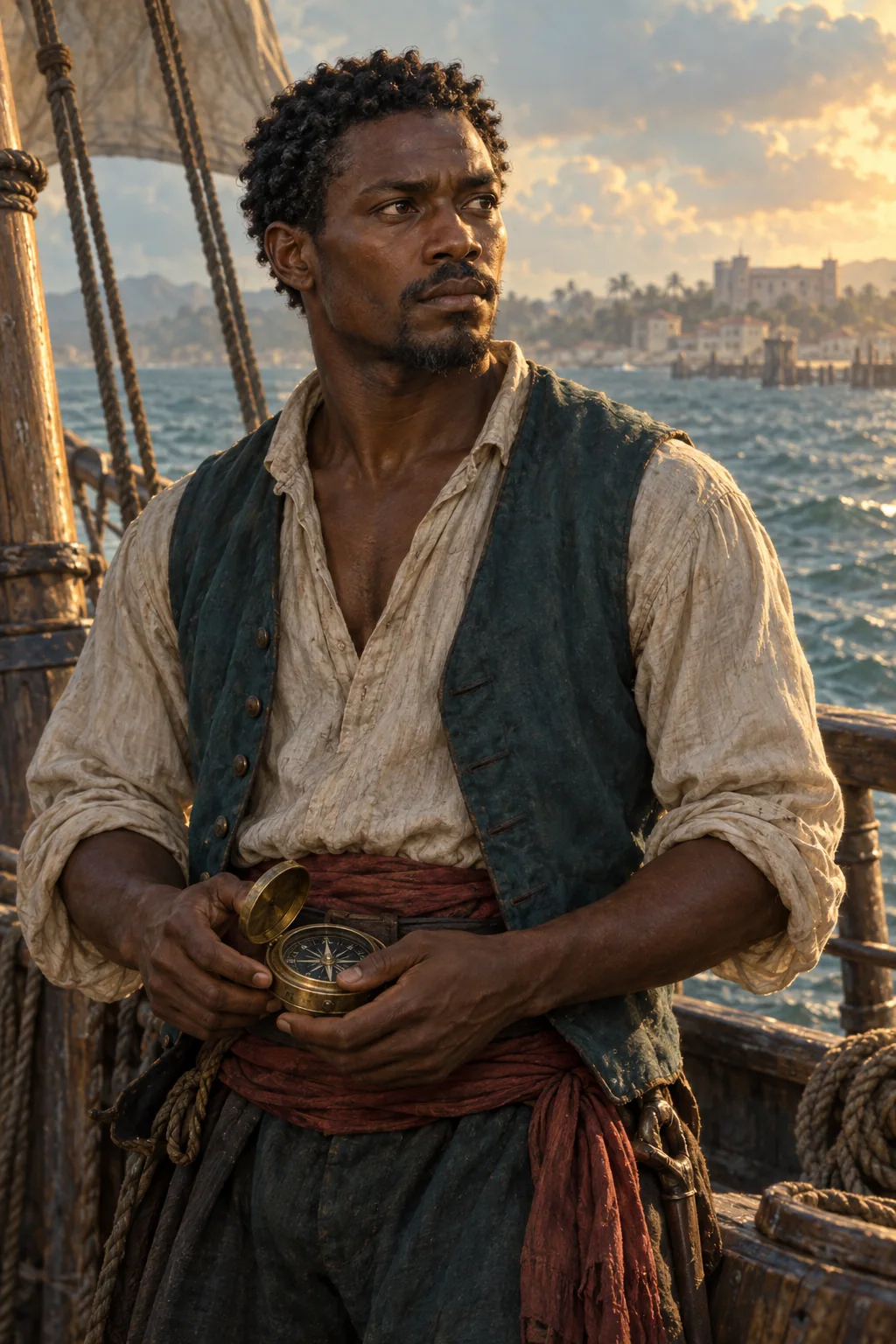
A pirate game set in Nassau the summer the pardon arrived
The Last Free Tide is a free pirate game you play online in your browser, with nothing to download. It is July 1718, the new governor's ships are off Nassau, and your captain is dying on the deck of the sloop Fortune. You take command for one tide. There are no sea battles to grind and no stat sheet: you make a run of hard decisions, and each one changes who keeps their freedom and who pays for it.
How The Last Free Tide plays
- You play
- A pirate who takes command of Fortune when her captain falls. Choose the Pilot, who knows the shoals around New Providence, or the Quartermaster, who divides the shares and speaks the crew's rules by heart. Each has a different goal of their own.
- Length
- About fifteen minutes. Three chapters: the burning harbour, the night beyond it, and the morning tide off New Providence.
- Decisions
- Fifteen, five in each chapter, each between two or three concrete choices. Crew support is the one meter; the ship's boat, the powder and the damage to Fortune's hull carry forward as real things you keep or lose.
- Endings
- Nine, on two broad routes: toward the king's pardon, or beyond the king's reach. You can also die with the ship or be put ashore by your own crew. Each run ends with a fate card, and you can replay the same tide as a different captain.
The pirate base at Nassau, 1715 to 1718
For about three years New Providence in the Bahamas was the main base of the Caribbean pirates. Modern books call it the Republic of Pirates, but no one at the time did. The government notice printed with the king's proclamation in September 1717 called Providence "the usual Retreat and general Receptacle for Pirates", and complained that they had also built a battery on Harbour Island nearby. The harbour at Nassau had two entrances, formed by a small island lying across its mouth, so a crew that saw one channel blocked could still leave by the other.
Charles Johnson's General History of the Pyrates, printed in London in 1724, lists the commanders who used the island in those years: Benjamin Hornigold, Edward Teach, Henry Jennings, Edward England, Charles Vane and about a dozen more. He then disposes of them in a single sentence: cast away, killed, murdered by their own men, hanged, or surrendered to the Spanish, with only England said to be living on at Madagascar.
The King's pardon and its price on a captain's head
George I's proclamation was signed at Hampton Court on 5 September 1717 and printed in the London Gazette that month. Any pirate who surrendered to a secretary of state or a colonial governor by 5 September 1718 would be pardoned for piracies committed before 5 January 1718. Nothing in it covered what a man did after that January date.
The second half of the proclamation is less often quoted. Anyone who seized a pirate who refused the pardon would be paid £100 for a commander, £40 for a lieutenant, master, boatswain, carpenter or gunner, £30 for an inferior officer and £20 for an ordinary hand. A pirate who handed over his own commander would receive £200, double the price anyone else could claim. The Crown was offering mercy and, in the same document, paying crews to turn on their captains.
Many took the first offer. Johnson says Jennings and about 150 others came in to the governor of Bermuda for their certificates, "tho' the greatest Part of them returned again, like the Dog to the Vomit."
Woodes Rogers and the arrival of July 1718
The man sent to enforce the pardon was not a naval officer but a Bristol privateer. Between 1708 and 1711 Woodes Rogers sailed round the world with the ships Duke and Duchess, rescued the castaway Alexander Selkirk from Juan Fernández in February 1709 after more than four years alone, and took a Manila treasure galleon off Baja California, a fight in which a bullet carried away part of his upper jaw. Even on his privateers, hard calls went to a majority vote of the officers' council.
His ship Delicia, escorted by the navy's Rose and Milford, anchored off Nassau late in July 1718. Johnson dates the arrival to "May or June", one of several places where his book is wrong on detail. According to the letters gathered by his 1928 editor, G. E. Manwaring, most of the pirates in the harbour were ready to accept the pardon. Charles Vane was not. He sent Rogers a letter offering to accept it only if he could keep his goods and "act as we think fit with everything belonging to us", and when the navy came in, he set fire to a captured French ship of 22 guns lying in the harbour. In the confusion he escaped through the other channel with about 90 men, firing at the warships as he went.
The next morning Rogers walked from the beach to the fort between two lines of pardoned pirates firing their muskets in salute. Keeping them was harder. When a pardoned captain named John Augur, sent out for provisions, went back to robbing ships, Rogers had him and his crew brought back and tried in December 1718. Johnson says the condemned men called from the gallows to some four hundred former shipmates standing by, and none of them moved. Rogers reprieved one young man "under the gallows". By 1721 he was writing that he had been left with "a few sick men to encounter five hundred of the pirates", and he went home in debt.
How a pirate crew actually ran
Pirate ships were not run like navy ships. Johnson, describing Vane's crew, gives the rule plainly: the captain's power was "absolute and uncontroulable" only "in fighting, chasing, or being chased; in all other Matters whatsoever, he is governed by a Majority." The crew chose almost everything else, including the captain.
The other officer who mattered was the quartermaster, "of the Mens own chusing". Johnson calls him "Trustee for the whole" and "a sort of a civil Magistrate on Board". He kept order between fights, punished small offences, checked that the men kept their weapons clean, and was first aboard any prize, deciding what went to the company and what was handed back. The captain and quartermaster were, in effect, two separate powers, and a crew that was unhappy with one could turn to the other.
Vane found out what that meant in November 1718. Chased by a French warship, he used his fighting authority to run rather than board, against the wishes of most of the crew and of his quartermaster, John Rackham. The next day the crew voted. They branded Vane a coward, deposed him, and gave him and the fifteen or so men who had sided with him a small captured sloop with enough food and ammunition to go their own way. On 24 November 1718 they elected Rackham captain. Johnson is the only source for much of this, and he wrote to sell books, so his dialogue should be read with care.
The real pirates of Nassau
Benjamin Hornigold was the senior captain of the Nassau years. Johnson says that late in 1716 Hornigold gave Edward Teach his first command, a captured sloop, and the two sailed together until shortly before Hornigold took the pardon. Teach, known as Blackbeard, left the Bahamas before Rogers came. In June 1718 he took the oath before the governor of North Carolina and settled near Ocracoke Island. On 22 November 1718 a Royal Navy force of about sixty men under Lieutenant Robert Maynard cornered him there, and he was killed in hand-to-hand fighting on the deck of Maynard's sloop.
Vane was later shipwrecked, recognised by a captain who had known him, carried to Jamaica and hanged in 1721. Rackham's luck lasted until the autumn of 1720, when a Jamaican sloop captured him and his small crew off the west end of the island. He was tried at St Jago de la Vega on 16 November 1720 and hanged at Gallows Point, Port Royal, two days later, and his body was hung in chains as a warning to others.
Two of his crew were women, Anne Bonny and Mary Read, tried on 28 November 1720. The printed trial record survives. A witness named Dorothy Thomas, robbed by Rackham's sloop, said the two women wore men's jackets, long trousers and handkerchiefs tied about their heads, and each carried a machete and a pistol. Two French captives said they wore men's clothes when chasing or attacking a ship and women's clothes at other times, and that they were there by their own free will. Johnson's famous story of a disguise kept secret from the whole crew goes further than the evidence. Both women were sentenced to hang, then told the court they were pregnant, and the sentence was stayed. Johnson says Read died of a fever in prison. Of Bonny he admits, "what is become of her since, we cannot tell."
What is real in The Last Free Tide
The setting is real: Nassau in July 1718, Woodes Rogers' arrival to restore royal government, the pardon and its limits, crew articles and votes, and the danger of a damaged wooden ship among the Bahamian shoals. The people are not. Fortune, Kit, Ruth, Reed and every encounter in the story are invented, and its bargains and hearings are a dramatic premise rather than a reconstruction of a documented pardon or trial. Crew support is a game abstraction. Along the way the game unlocks short history notes, each with its sources, that explain what the story is built on.
Sources
- Charles Johnson · A General History of the Pyrates (1724), Project Gutenberg
- The London Gazette 5573 (September 1717) · the Proclamation for Suppressing of Pirates
- Woodes Rogers · A Cruising Voyage Round the World, ed. G. E. Manwaring (1928), Project Gutenberg
- The Tryals of Captain John Rackam, and Other Pirates (Jamaica, 1721), Internet Archive
- Woodes Rogers · Bahamas National Archives
- Blackbeard at Ocracoke · National Park Service, Cape Hatteras
- Pirates: fact or fiction? · Royal Museums Greenwich