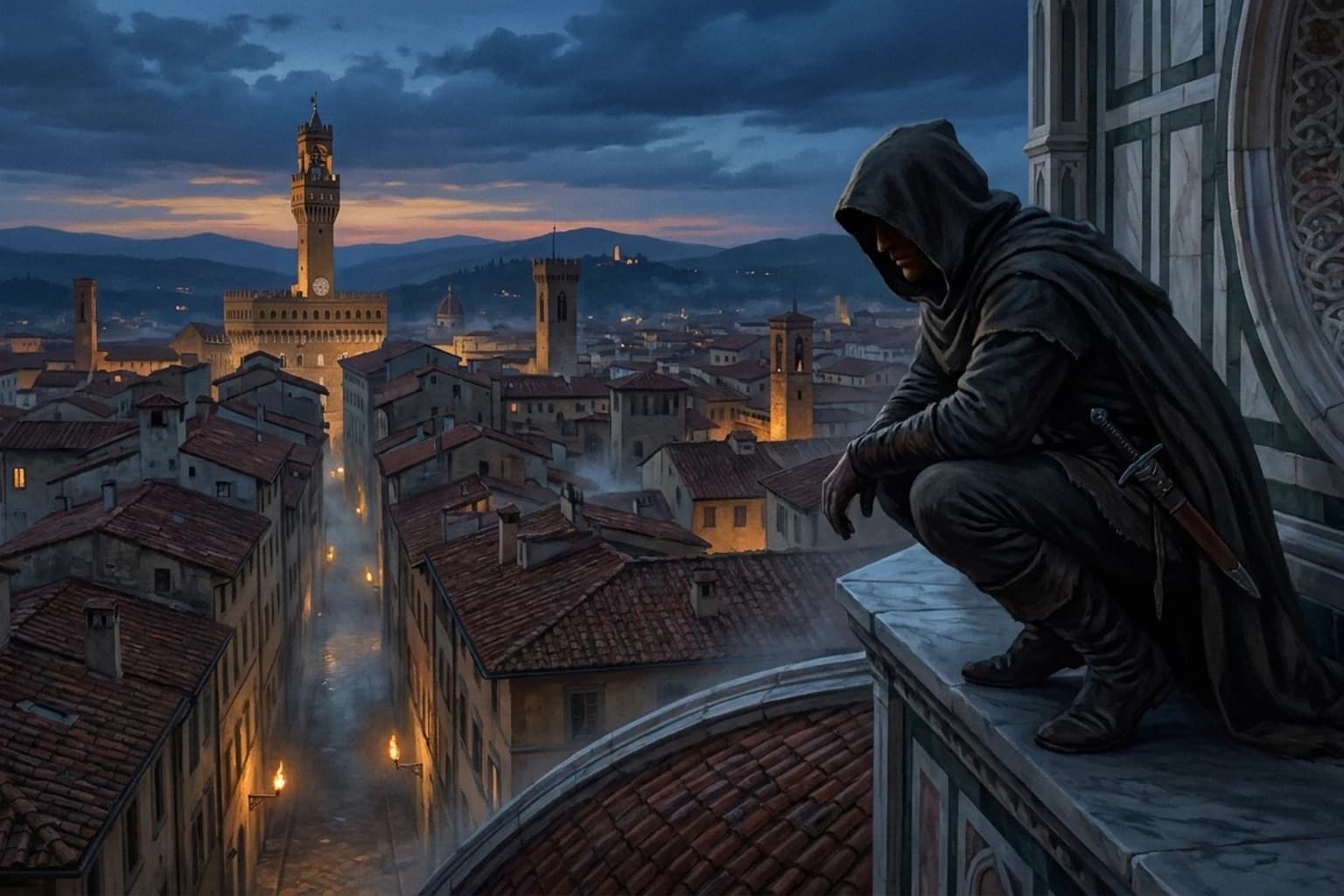
What Happened on 26 April 1478
At around eleven in the morning, during High Mass in Florence cathedral, a group of conspirators attacked the two men who ran the city. Giuliano de' Medici, aged twenty-four, was stabbed to death near the choir on the north side of the church. His elder brother Lorenzo, aged twenty-nine, took a cut to the neck, vaulted the altar rail and got into the sacristy before the heavy bronze doors were shut behind him.
The plot was meant to end Medici rule in Florence. Within three days its authors were hanging from the windows of the town hall, and within two years the Medici were more powerful than they had ever been. It is one of history's cleanest examples of an assassination achieving the precise opposite of its purpose.
It Was Not Easter Sunday
Almost every popular retelling, including a well-known television series, stages the attack on Easter Sunday. It is wrong. Easter in 1478 fell on 22 March. The 26th of April was a Sunday, but it was the fifth Sunday after Easter.
The contemporary record settles it without ambiguity. The Florentine apothecary Luca Landucci, whose diary is the closest thing we have to a daily log of the city, records Giuliano's funeral on 30 April as Ascension Day. Ascension falls thirty-nine days after Easter, which puts Easter on 22 March exactly. The detail matters because the Easter version makes the sacrilege sound even more theatrical than it was, and the real thing needs no help.
Why the Pazzi Wanted the Medici Dead
Alum, and the papal account
Alum is a mineral salt that fixes dye to cloth. Without it the European textile industry does not function, and before 1462 most of it came from Ottoman territory. When a large deposit was found at Tolfa in the Papal States that year, the papacy created a monopoly on it and appointed the Medici bank as the distributor. Combined with the papal accounts, this made the Medici the richest and best-connected bankers in Europe.
Imola, and a refused loan
In 1473 Pope Sixtus IV moved to buy the town of Imola, on the road between Bologna and Rimini, as a lordship for his nephew Girolamo Riario. Florence regarded that territory as its own buffer, and Lorenzo had wanted Imola himself. When the pope asked the Medici bank to finance the purchase, Lorenzo refused.
The Pazzi bank lent the money instead. Sixtus then stripped the Medici of the papal accounts and the alum contract and handed both to the Pazzi. This is the hinge of the entire story. In a single move the Medici lost their most valuable business to their nearest domestic rival, and that rival acquired the money and the papal protection to challenge them at home.
The archbishop Lorenzo locked out
In October 1474 Sixtus appointed Francesco Salviati, a Pazzi relative and open enemy of the Medici, as Archbishop of Pisa. Pisa was Florentine territory and the appointment was made without Florentine consent. Lorenzo simply refused to let him take the seat, and barred him from the city for two years. Salviati was finally installed in 1476 and joined the plot to kill the man who had humiliated him.
The inheritance law
Machiavelli, writing a few decades later, treats the domestic squeeze as decisive. The Pazzi were consistently passed over for public office despite their wealth and standing. Then Giovanni de' Pazzi married the sole heir of a very rich Florentine, and when the estate was disputed the city passed a law, applied retroactively, that redirected the entire inheritance to a male cousin. Machiavelli says the family "at once recognised the influence of the Medici," and reports that Giuliano himself warned his brother that by grasping at too much they risked losing everything.
The Pope's Careful Sentence
The conspirators needed papal cover, and they sent a professional soldier in papal service, Giovanni Battista da Montesecco, to get it. His written confession, taken before his execution, is the closest thing to a transcript of what Sixtus IV agreed to.
By that account the pope wanted the Medici government gone but would not sanction murder. He said he did not desire anyone's death, that it did not accord with his office, and then: go, and do what you wish, provided there be no killing. It is a sentence built to survive being repeated back to him. He then supplied troops, money and diplomatic cover to men whose plan he knew perfectly well, and after the attack failed he excommunicated the victim.
Florence understood exactly how damaging the confession was, which is why the document was suppressed for months. When it was finally published in August 1478, every reference to the King of Naples and the Duke of Urbino had been cut out of it.
The Soldier Who Walked Away
Montesecco was assigned to kill Lorenzo. He refused to do it inside a church. The Italian biographical record offers two possible reasons and does not choose between them: the sacrilege itself, or the fact that he had actually met Lorenzo, been received graciously, and found him nothing like the tyrant he had been sold.
His replacements were two priests: Stefano da Bagnone, a household chaplain to the Pazzi, and Antonio Maffei, a scribe from Volterra. Neither had killed anyone. The original plan had been a banquet, and it was only changed to the cathedral that morning when word came that Giuliano would not attend the meal.
So the most consequential decision of the day was made before anyone drew a knife. The conspirators swapped a mercenary for two amateurs at short notice. Giuliano's killers were experienced men and they did their work in seconds. Lorenzo's were not, and they managed a shallow cut to the neck. Everything that followed, including the destruction of the Pazzi and forty more years of Medici rule, turns on that substitution.
Inside the Cathedral
Francesco de' Pazzi and Bernardo Bandini Baroncelli collected Giuliano from his house and walked him to the cathedral, joking with him the whole way. Machiavelli says Francesco embraced him along the route, ostensibly in friendship, actually to check whether he was wearing armour under his clothes. He was not.
The signal came during the Mass, though the sources disagree on which moment: Landucci says the elevation of the host, Machiavelli says the celebrant taking communion. Bandini struck first, a short dagger to the chest. Giuliano took a few steps and went down. Francesco de' Pazzi then threw himself on the body and stabbed with such frenzy that he drove the blade into his own thigh, a wound deep enough that it later helped identify him. The count of nineteen wounds is traditional rather than documented, and the contemporary sources give no number.
Bandini then killed Francesco Nori, the Medici bank manager, who appears to have put himself between the assassins and Lorenzo, and ran for the sacristy. He was too late. Through all of it the seventeen-year-old cardinal whose visit had provided the cover for the whole plot stood frozen at the altar, and was kept alive by the priests around him. Landucci wrote that the uproar was such that it seemed almost enough to bring the church down on the people inside it.
The City Answered Within the Hour
The second half of the plan was a simultaneous seizure of the town hall. Archbishop Salviati went to the Palazzo della Signoria with a party of men to take the building and kill the head of government. It failed almost comically. The Gonfaloniere, Cesare Petrucci, saw through him immediately and raised the alarm, and Salviati's men found themselves trapped in a chancery room by a door that locked behind them.
Meanwhile Jacopo de' Pazzi, the head of the family, rode into the public square shouting for the people and for liberty. Nobody joined him. That silence is the most politically revealing moment of the entire episode, and Machiavelli is merciless about it: Florentines had been made deaf by Medici fortune, and liberty, he wrote, was unknown in the city.
What the crowd did instead was lynch the conspirators. By that evening Salviati was hanging in his vestments from a window of the Palazzo della Signoria, with Francesco de' Pazzi hanging naked beside him and about twenty more men strung from the public buildings. Jacopo fled, was caught at Belforte and hanged on 28 April. Landucci counted more than seventy dead in three days. Most accounts put the eventual total near eighty executions, though the numbers in circulation vary a great deal and no reliable reconciliation exists.
What They Did to Jacopo de' Pazzi
He was buried in the family tomb at Santa Croce. On 15 May the body was dug up and reburied in unconsecrated ground outside the city wall. Two days later, in the late afternoon, a group of boys dug it up a second time and dragged it through the streets of Florence by the rope still knotted around its neck.
At the door of the Pazzi palace they tied the rope to the door-bell and shouted for someone to answer. Then they hauled the corpse to the bridge at Rubaconte and threw it in the Arno, singing a rhyme as it went, and crowds gathered on the bridges to watch it float away. Downstream at Brozzi it was pulled out again, hung from a willow, beaten, and thrown back in the river. Landucci, who watched much of this, noted with genuine bewilderment that children are normally frightened of corpses, and this one had been above ground for three weeks.
Erasing a Family
On 23 May 1478 Florence passed a decree that went beyond punishing the guilty. The Pazzi surname was banned. Surviving members had to change their name and their coat of arms. Every representation of the family emblem in the city was to be erased or covered, with a fine for any craftsman who carved the old one. All Pazzi property was confiscated. And no Florentine was permitted to marry a Pazzi, which is a provision aimed not at the living family but at the possibility of a future one.
The city also commissioned Sandro Botticelli, the most admired painter in the Medici circle, to paint the hanged conspirators on a wall beside the Palazzo della Signoria as defamatory portraits. Eight figures, in the civic heart of Florence, where everyone conducting business had to walk past them. They stayed up for about sixteen years and were destroyed in 1494, when the Medici were themselves driven out.
The Assassin Who Ran to Constantinople
Bernardo Bandini Baroncelli, who struck the first blow, got out of Italy. He fled through Naples and kept going until he reached Constantinople, on the reasonable assumption that the Ottoman Empire lay beyond the reach of a Florentine banker.
It did not. Lorenzo worked through the Florentine consul in the city, and Sultan Mehmed II had Bandini arrested on 23 December 1479 and handed over. He was hanged from a window of the Palazzo del Capitano five days later, still wearing the Turkish clothes he had been captured in.
Leonardo da Vinci, then living in Florence, stood in front of the body and drew it. The sketch survives, and in the mirror writing beside the hanging figure he noted the dead man's clothing the way a painter notes materials: a tan-coloured cap, a doublet of black serge. It is a study of fabric, made from a corpse, by the most curious man of the age.
Excommunication and the Pazzi War
Sixtus IV's response tells you everything about where he stood. On 1 June 1478 he excommunicated Lorenzo and the Florentine government. The stated grounds were not the murder of Giuliano. They were Florence's execution of Archbishop Salviati, a churchman, and its detention of a cardinal. On 22 June he placed the whole city under interdict, suspending Mass and communion for everyone in it.
Florence fought back on paper first, commissioning legal opinions arguing that Salviati had been taken armed and out of clerical dress in the act of storming the government, and was therefore killable without incurring excommunication. Lorenzo's own summary, in a letter that June, was blunter: he had committed no offence against the pope except being alive.
Then came the war. Naples declared on 13 July 1478 with an explicit offer: peace, if Florence expelled Lorenzo. Florence refused, which is the single clearest measure of how completely the conspiracy had backfired. The fighting went badly for two years, and by late 1479 Lorenzo's position was eroding. In December he did the most reckless thing of his life and sailed to Naples to put himself personally in the hands of a king who had murdered inconvenient men before. He stayed roughly ten weeks, argued that a destroyed Florence served only the pope, and came home in March 1480 with a peace. What finally broke the papal coalition was not diplomacy at all: an Ottoman force landed at Otranto in August 1480, and Naples had rather more urgent problems than Tuscany.
Why It Backfired So Completely
The conspiracy was designed to end Medici rule. It entrenched it, in four distinct ways.
- It removed the only rival. The Pazzi were the one family in Florence with the wealth, the name and the papal backing to contest Medici primacy. After April 1478 they did not exist as a political force.
- It proved there was no republican constituency. Jacopo rode out calling for liberty and the square stayed empty. Everyone in Florence learned that day that the opposition had no public behind it.
- It made Lorenzo a cause. A man who had been the head of a faction became the survivor of a sacrilege. Naples offered peace in exchange for his exile and the city refused.
- It was cashed in constitutionally. Weeks after the peace, in April 1480, Florence created the Council of Seventy, a small standing body of Medici loyalists that absorbed the powers of the older councils. That is the formal step from influence to control.
There is one more coda. Giuliano died on 26 April 1478. One month later, on 26 May, his son Giulio was born. Lorenzo raised the boy in his own household, and he grew up to become Pope Clement VII. The conspiracy that was meant to drive the Medici out of Florence put a Medici on the papal throne inside two generations.
Knowledge Check
Why did the assassination of Lorenzo fail?+
The professional soldier hired to kill him, Giovanni Battista da Montesecco, refused to commit murder inside a church. He was replaced at short notice by two priests with no combat experience, who managed only a shallow cut to Lorenzo's neck. The conspirators swapped a mercenary for amateurs, and that substitution is the reason the Medici survived.
What did Pope Sixtus IV do after the attack failed?+
He excommunicated Lorenzo. The stated grounds were not the murder of Giuliano but Florence's execution of Archbishop Salviati, a churchman, and its imprisonment of a cardinal. Three weeks later he placed the entire city under interdict, suspending Mass and communion.
What happened to Jacopo de' Pazzi's body?+
He was hanged on 28 April and buried at Santa Croce, then dug up on 15 May and reburied in unconsecrated ground outside the walls. Two days later boys exhumed him again, dragged the corpse through Florence by the rope still around its neck, and threw it in the Arno.
Who ended up on the papal throne because of the conspiracy?+
Giuliano's son. Giulio de' Medici was born on 26 May 1478, exactly one month after his father was murdered, and was raised by Lorenzo. He became Pope Clement VII, the pope of the Sack of Rome and of Henry VIII's divorce.
Frequently Asked Questions
What was the Pazzi conspiracy?+
A plot by the Pazzi banking family, the Archbishop of Pisa and the nephew of Pope Sixtus IV to kill Lorenzo and Giuliano de' Medici and overthrow Medici control of Florence. The attack took place on Sunday 26 April 1478 during High Mass in Florence cathedral. Giuliano was killed. Lorenzo was wounded in the neck and escaped, and the reprisals that followed destroyed the Pazzi family entirely.
Did the Pazzi conspiracy happen on Easter Sunday?+
No, and this is the single most repeated error about it. Easter in 1478 fell on 22 March. The attack was on Sunday 26 April, the fifth Sunday after Easter. The contemporary Florentine diarist Luca Landucci records Giuliano's funeral on 30 April as Ascension Day, which is 39 days after Easter and confirms the March date independently.
Why did the Pazzi want to kill the Medici?+
Money first, then politics. Pope Sixtus IV wanted to buy the town of Imola for his nephew, Lorenzo refused to lend him the money, and the Pazzi bank financed it instead. Sixtus responded by taking the papal accounts and the lucrative alum monopoly away from the Medici and giving both to the Pazzi. On top of that, Lorenzo blocked the Pazzi from public office and backed a retroactive law that stripped a Pazzi wife of a large inheritance.
Was Pope Sixtus IV involved?+
He approved the overthrow but, according to the confession of the soldier hired to do it, refused to sanction killing. Giovanni Battista da Montesecco recorded the pope saying he did not want anyone's death, and then: go, and do what you wish, provided there be no killing. Sixtus supplied troops, money and diplomatic cover, and after the attack he excommunicated Lorenzo rather than the conspirators.
How many people died?+
Two on the day: Giuliano de' Medici and Francesco Nori, the Medici bank manager who was killed trying to shield Lorenzo. Then the reprisals. Landucci, who lived in Florence and watched, counted more than seventy dead in the first three days. Most accounts put the total at roughly eighty executions over the following six months, though the figures in circulation vary widely.
What happened to the Pazzi family?+
They were erased. A decree of 23 May 1478 banned the surname outright, ordered the family arms chiselled off every building in Florence, confiscated their property and forbade any Florentine to marry a Pazzi. Survivors were imprisoned or exiled. The family was only rehabilitated after the Medici themselves were expelled in 1494.
Sources
- ·Luca Landucci, A Florentine Diary from 1450 to 1516, trans. Alice de Rosen Jervis — the contemporary day-by-day record
- ·Niccolò Machiavelli, History of Florence, Book VIII
- ·Marta Celati, The conflict after the Pazzi conspiracy and Poliziano's Coniurationis commentarium, University of Warwick (open access)
- ·Treccani, Dizionario Biografico degli Italiani — entries for Giovanni Battista da Montesecco and Francesco Salviati
- ·The Frick Collection — Bertoldo di Giovanni's Pazzi Conspiracy medal, 1478 (Bargello inv. 5957)
- ·Italian Art Society — on the capture of Bernardo Bandini Baroncelli in Constantinople