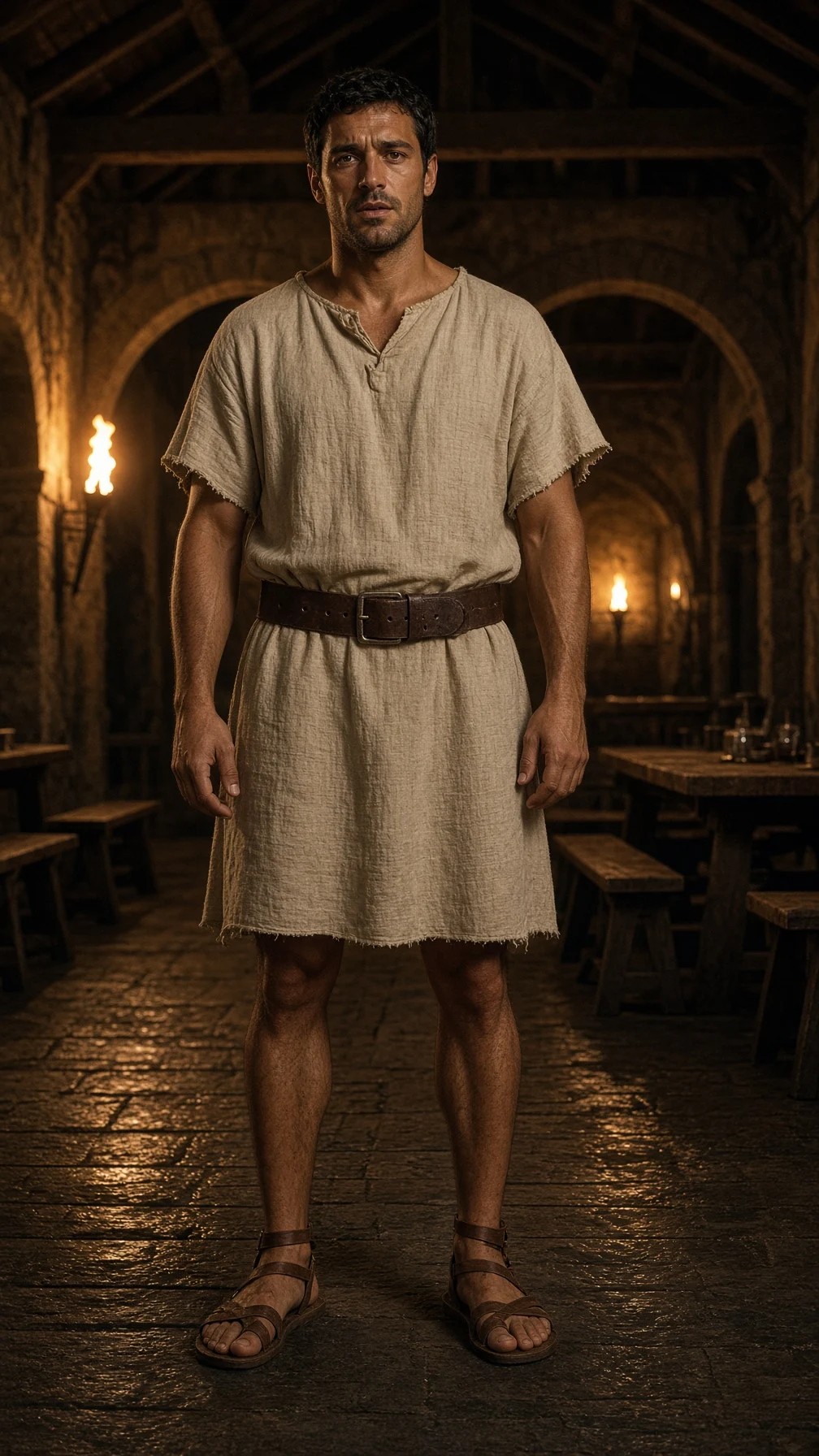
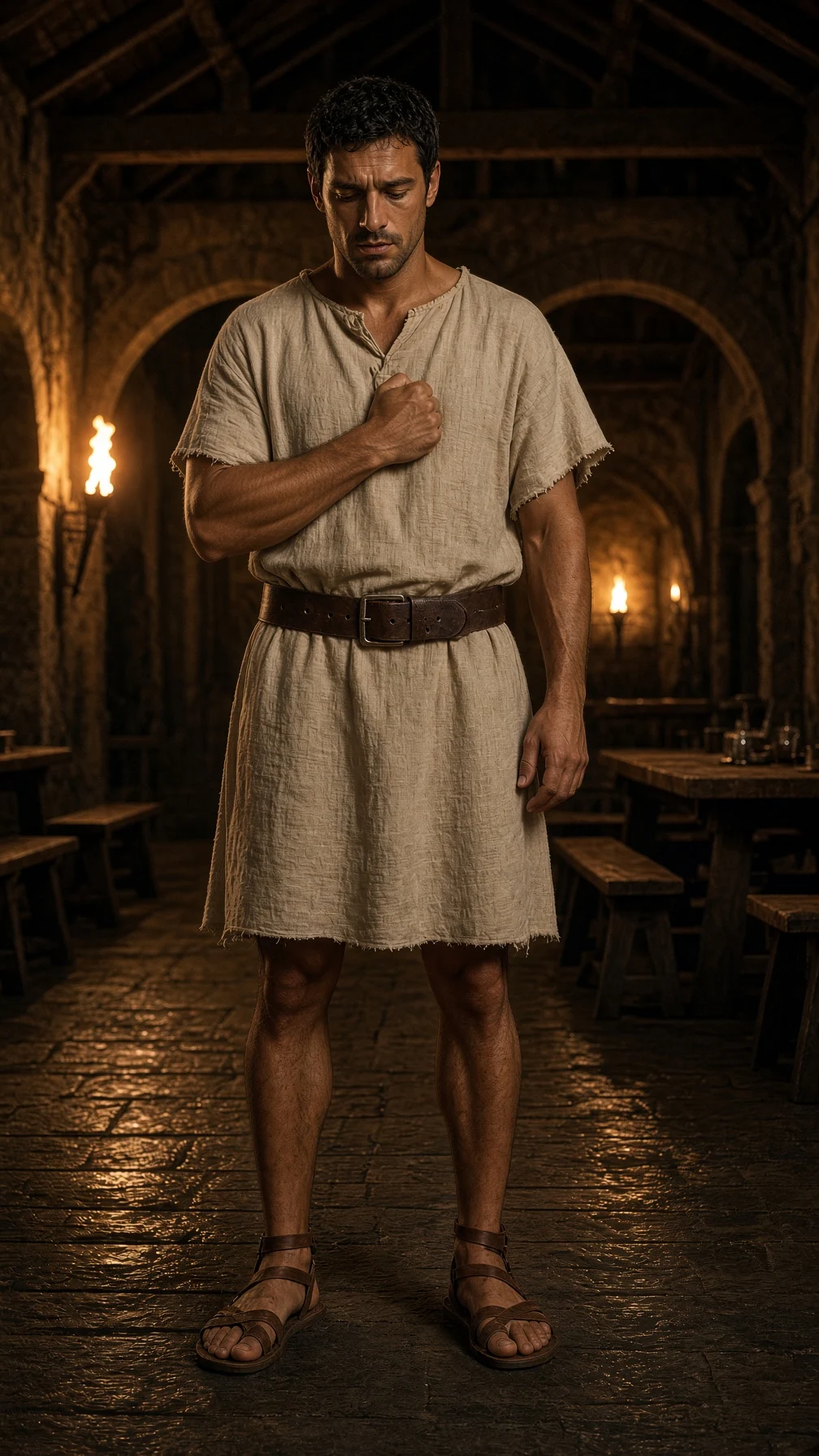
A gladiator game set at the Colosseum's opening games
The Wooden Sword is a free, browser-based gladiator game from HistoryForge. You play one afternoon at the Flavian Amphitheatre in 80 CE, the summer the emperor Titus opened it. There is no grinding and no stat sheet: you make a handful of decisions, and each one changes who walks out through the Gate of Life.
How The Wooden Sword plays
- You play
- A free Roman who signed on to fight for one payday, to clear a debt that threatens his wife's workshop.
- Length
- About ten minutes. Two acts: the night before the games, then the afternoon on the sand.
- Decisions
- Eight, each between two or three concrete choices. The crowd's mood, your wounds and the gear you chose all carry forward.
- Endings
- Several, from walking out with the purse to dying on the sand or being seized at the gate. Each run ends with a fate card you can share, and you can replay as a different man under the same oath.
The Colosseum's first games, 80 CE
Vespasian began the amphitheatre in the early 70s CE on the drained site of Nero's private lake, a public building on ground the hated emperor had taken for himself. His son Titus dedicated it in 80 CE with games that, according to Suetonius, ran for a hundred days. The building we call the Colosseum was then the Flavian Amphitheatre, named for the family that built it, and it held something like fifty thousand people.
The historian Cassius Dio, writing more than a century later, says nine thousand animals were killed during the opening games, and that the arena was even flooded for a staged sea battle. Historians still argue about whether that naval show happened inside the Colosseum or at a separate artificial lake. The poet Martial wrote a short book of epigrams for the occasion, the Liber de spectaculis, and it is the closest thing to an eyewitness account that survives.
Who fought in the arena
Most gladiators were enslaved men, prisoners of war or criminals sentenced to a gladiatorial school. A smaller group were free volunteers who signed a contract with a lanista, the owner and manager of a troupe, in exchange for money. The Wooden Sword's hero is one of those volunteers, which is why the game begins with a contract and a debt rather than a chain.
A fighter's career was usually short, but it was not necessarily a single fight. Trained gladiators were expensive to replace, and a man who survived several bouts and kept the crowd's favour could earn prize money, a following and, eventually, release. The symbol of that release was the rudis, a wooden practice sword handed to a gladiator who had earned his discharge. It gives the game its name.
Training at a gladiator school
Gladiators lived and trained in a ludus, a school with its own trainers, armourers and doctors. Training began with wooden weapons against a post before moving to sparring, and each man specialised in one fighting style. The great training school beside the Colosseum, the Ludus Magnus, was built a few years after these games under Domitian, and part of its small practice arena can still be seen next to the amphitheatre.
Excavations of a gladiators' cemetery at Ephesus in Turkey have told us what these men ate. Chemical analysis of their bones points to a diet based on barley and beans, which fits the Roman nickname for gladiators, hordearii, the barley men. The same study found unusually high strontium levels, consistent with ancient writers who say fighters drank a tonic made from plant ash to strengthen their bones.
Types of gladiator
Bouts were not free-for-alls. Promoters paired fighting styles that contrasted, so that each side had an advantage the crowd could follow. A murmillo carried a large rectangular shield, a short sword and a crested helmet; he was often matched with a thraex, who fought with a small shield and a curved blade. The retiarius fought almost unarmoured with a net, a trident and a dagger, and by the late first century he was usually matched against the secutor, the chaser, whose smooth helmet gave a net little to catch.
In the game, the gear you choose before the bout matters for the same reason it mattered on the sand: a heavy shield buys protection and costs stamina, and a fighter who has read his opponent's style can turn it against him.
A day at the games
A full day of games followed a rough order. Mornings belonged to the venationes, hunts and fights involving wild animals. The middle of the day was often given over to public executions of condemned criminals, a part of the programme the philosopher Seneca describes with disgust in one of his letters. The gladiators, the main event, fought in the afternoon.
The man who paid for the games, the editor, presided and decided the fate of a defeated fighter who appealed for mercy, usually after reading the mood of the crowd. Popular imagination has the crowd turning its thumbs down for death, but the Latin sources only say the thumb was turned, pollice verso, and nobody is sure which way. Fighters who survived left by the Gate of Life, the Porta Sanavivaria. The dead were carried out through the Porta Libitinensis, named for Libitina, the goddess of funerals.
What is real in The Wooden Sword
The setting is real: the opening games of 80 CE, the volunteer's contract, the editor's judgement, the gates and the crowd. The people are not. The hero, his wife Aelia, his trainer Felix and the lanista who offers him a bargain are invented, and the fixed bout at the centre of the story is a dramatic premise rather than a documented event. Along the way the game unlocks short history notes, each with its sources, that explain what the story is built on.
Sources
- Suetonius · Life of Titus 7 (LacusCurtius)
- Cassius Dio · Roman History 66.25 (LacusCurtius)
- Martial · Liber de spectaculis (Latin text)
- Seneca · Epistles 7 (Latin text)
- Juvenal · Satire 3 (Latin text)
- Lösch et al. 2014 · Stable isotope and trace element studies on gladiators from Ephesus, PLOS ONE
- The Roman Gladiator · Encyclopaedia Romana, University of Chicago