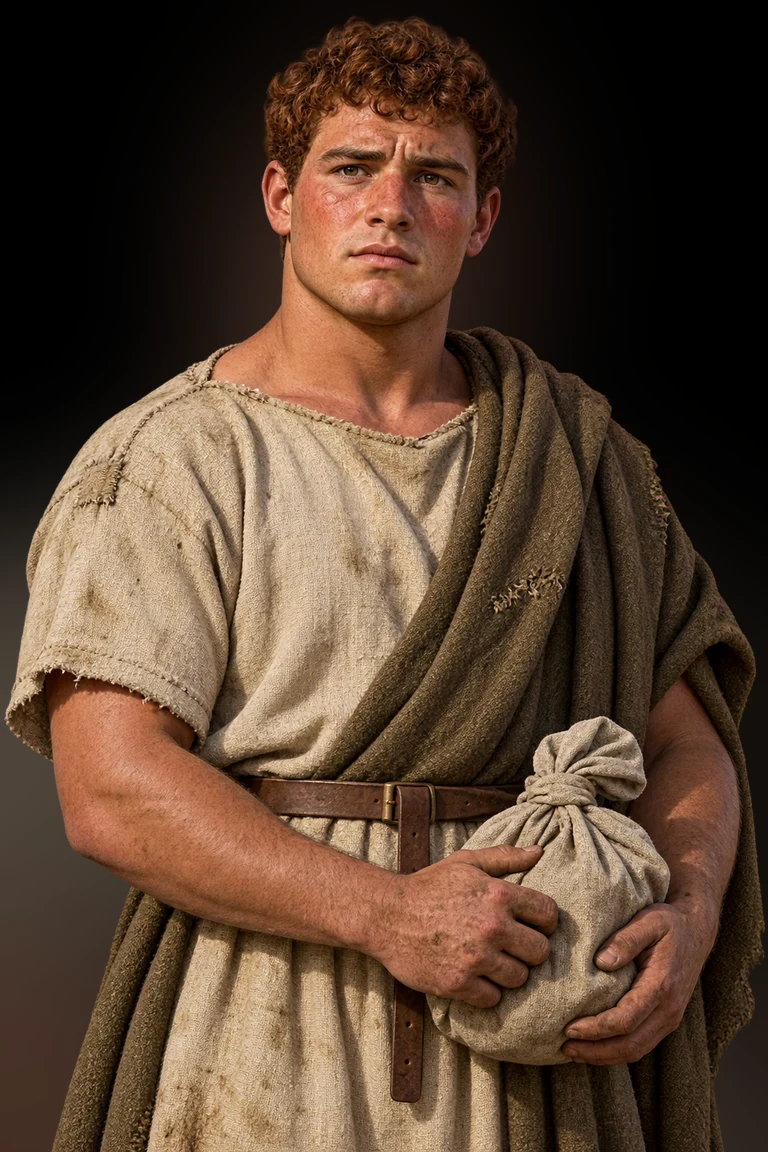
A Roman soldier game set in Caesar's war in Gaul
The Eagle's Price is a free, browser-based Roman legion game from HistoryForge. It is a story game, not a strategy game: there are no armies to push across a map. You are one citizen soldier who joined Caesar's army as nobody in 58 BCE, and across three campaigns you decide what to risk, and whom, to become a name the general remembers.
How The Eagle's Price plays
- You play
- An ordinary legionary who was a farmer or a scribe before enlisting, serving beside your tentmate Lucius under a centurion who expects you to hold your place in the line.
- Length
- Three chapters, roughly half an hour in all: the Sabis in 57 BCE, Quintus Cicero's besieged winter camp in 54 BCE, and Alesia in 52 BCE. Your run saves, so you can stop between chapters.
- Decisions
- Twenty-four, eight per chapter, each between two or three concrete choices. Wounds, comrades lost or saved and what your officers actually witnessed all carry forward.
- Rank and endings
- Rank is earned, never scored: recruit, veteran, optio, centurion. There are several endings and several ways to die, and a fall in battle can send you back to try the chapter again. Each run ends with a fate card you can share.
A legionary's life in Caesar's army
Caesar's legions were citizen armies of the late Republic. The smallest unit was the contubernium, usually eight men who shared a leather tent and cooked together. Ten of those made a century of eighty under a centurion, six centuries made a cohort, and ten cohorts made a legion of about 4,800 men on paper. Few legions stayed near that strength once they had been campaigning.
Older textbooks credit this army to one package of reforms by Gaius Marius around 107 BCE. Historians now see a slower change, though Marius did open the ranks to men with no property, and Plutarch says he made soldiers carry their own kit, which earned them the nickname Marius's mules. Suetonius says Caesar doubled the legions' pay for good, and after Alesia he gave every man in the army one captive as booty.
Above the rank and file stood a ladder of centurions. Each cohort had six, holding posts called hastatus, princeps and pilus, each in a senior and junior grade, and a legion's sixty centurions ranked from the most junior post in the tenth cohort to the primus pilus of the first. Each century also had an optio, the centurion's chosen deputy, and a signifer who carried its standard. Caesar says he moved centurions up that ladder for courage.
The legion's own standard was the eagle. Pliny the Elder says Marius, in his second consulship in 104 BCE, made the aquila the only legionary standard; before that legions also marched behind a wolf, a minotaur, a horse and a boar. Caesar tells two eagle stories: the eagle-bearer of the Tenth who jumped into the surf off Britain in 55 BCE, telling the men to follow unless they wanted to betray the eagle to the enemy, and Lucius Petrosidius, who in 54 BCE threw his eagle inside the rampart at Atuatuca and died fighting in front of the camp.
Caesar's Gallic War, and how we know it
Nearly everything known about these campaigns comes from the man who led them. Caesar's Commentaries on the Gallic War cover 58 to 52 BCE in seven books, one per fighting season, written in a plain third person in which Caesar does things as if a neutral observer were reporting. An eighth book, covering 51 and 50 BCE, was added later by his officer Aulus Hirtius.
Ancient readers admired the style. Cicero, no friend of Caesar's politics, called the commentaries bare, upright and graceful, stripped of ornament like a body of its clothes, and said that Caesar had meant to give historians raw material but had put sensible men off writing the history at all. Not everyone trusted them. Suetonius preserves the verdict of Asinius Pollio, who served under Caesar, that they were careless and not wholly truthful, because Caesar believed others' reports too readily and misreported his own actions, on purpose or from a lapse of memory.
The books were politics as well as history. Caesar's command was fiercely contested in Rome, and his reports won him public thanksgivings voted by the Senate: fifteen days after 57 BCE, which he notes no one had ever been granted before, and twenty after 52 BCE. Not every senator was impressed. Plutarch says that after Caesar's slaughter of the Usipetes and Tencteri in 55 BCE, Cato proposed handing him over to the Germans. Caesar's enemy numbers, often in the hundreds of thousands, are claims, not counts.
The revolt of 52 BCE and Vercingetorix
At the end of 53 BCE Caesar left for Italy with Gaul, as he puts it, quiet. The winter proved otherwise. In January 52 BCE the politician Clodius was murdered on the Appian Way and Rome erupted in riots, and Gallic leaders, Caesar says, saw their chance while he was held in Italy and cut off from his legions. The Carnutes struck first, killing the Roman traders settled at Cenabum, modern Orléans. Caesar says the news travelled about 160 miles to the Arverni before the end of the first watch of the night, shouted from field to field.
Among the Arverni a young noble named Vercingetorix raised an army. His father Celtillus had once held the leadership of all Gaul and had been killed by his own people for aiming at kingship, and his uncle Gobannitio had Vercingetorix thrown out of the town of Gergovia. He gathered supporters in the countryside, was hailed as king and held his alliance together with harsh discipline. Gold coins stamped with his name still survive. Caesar answered at speed, crossing the Cévennes in winter through snow he says lay six feet deep.
Vercingetorix's best weapon was hunger: burn the towns and farms in Caesar's path and pick off his foragers. The Bituriges begged him to spare Avaricum, modern Bourges, and he gave way. Caesar took it after a hard siege and says that of about 40,000 people inside, barely 800 reached Vercingetorix. At Gergovia an assault went wrong and Caesar admits losing nearly 700 men, 46 of them centurions. Then the Aedui, Rome's oldest allies in Gaul, joined the revolt, and a council of Gauls at Bibracte confirmed Vercingetorix as supreme commander.
The siege of Alesia
In late summer 52 BCE Vercingetorix fell back with his army to the hill town of Alesia, now Mont Auxois above Alise-Sainte-Reine in Burgundy. Caesar chose to enclose it. He describes an inner ring facing the town, about eleven Roman miles round with twenty-three forts, and then, when he learned a Gallic relief army was gathering, an outer ring of fourteen miles facing outward.
Book VII reads like an engineer's report: a twenty-foot trench with vertical sides, two more trenches fifteen feet wide, one flooded from the river, and a rampart with a palisade twelve feet high and towers every eighty feet. In front lay obstacles the soldiers named with grim humour. Cippi, grave markers, were rows of sharpened branches; lilia, lilies, were pits set in eight rows, each with a fire-hardened stake hidden under brushwood; stimuli were foot-long blocks of wood fixed with iron hooks and buried in the ground.
Caesar puts the relief army at 8,000 cavalry and about 250,000 infantry, a figure most historians think far too high, and the force inside Alesia at 80,000. The decisive attack fell on a weak point in the north, where a Roman camp sat on lower ground below a hill too large to bring inside the works. He records the surrender in a few flat lines. The famous scene of Vercingetorix riding out in his finest armour, circling Caesar and laying his weapons at his feet comes from Plutarch, writing about a century and a half later. Cassius Dio says he was kept in chains, led in Caesar's triumph in 46 BCE, six years after Alesia, and then put to death.
Where Alesia stood was argued for centuries. Napoleon III had Mont Auxois excavated in the 1860s, and a Franco-German excavation in the 1990s traced the Roman lines and found pits matching the obstacles Caesar describes, which settled the question for most scholars. The MuséoParc Alésia now stands on the plain below the hill.
What is real in The Eagle's Price
The campaigns are real: the battle against the Nervii at the river Sabis in 57 BCE, the siege of Quintus Cicero's winter camp in 54 BCE and the siege of Alesia in 52 BCE, all described in Caesar's own account. Caesar and Quintus Cicero are historical. Your soldier, your tentmate Lucius Varro, the centurion Titus Atilius, the veteran Decimus Rufus and the tribune Serranus are invented, and their actions, appointments and private conversations do not reconstruct documented lives. The Roman victories stay as history recorded them; the lives and costs inside your story can change. Along the way the game unlocks short history notes, each with its sources, on what the story is built on.
Sources
- Caesar · The Gallic War, English translation (LacusCurtius)
- Caesar · De Bello Gallico Book VII (Latin text)
- Suetonius · Life of Julius Caesar (LacusCurtius)
- Plutarch · Life of Caesar (LacusCurtius)
- Cassius Dio · Roman History 43 (LacusCurtius)
- Cicero · Brutus (Latin text)
- Pliny the Elder · Natural History 10.5, the eagle as legionary standard (Perseus)
- MuséoParc Alésia