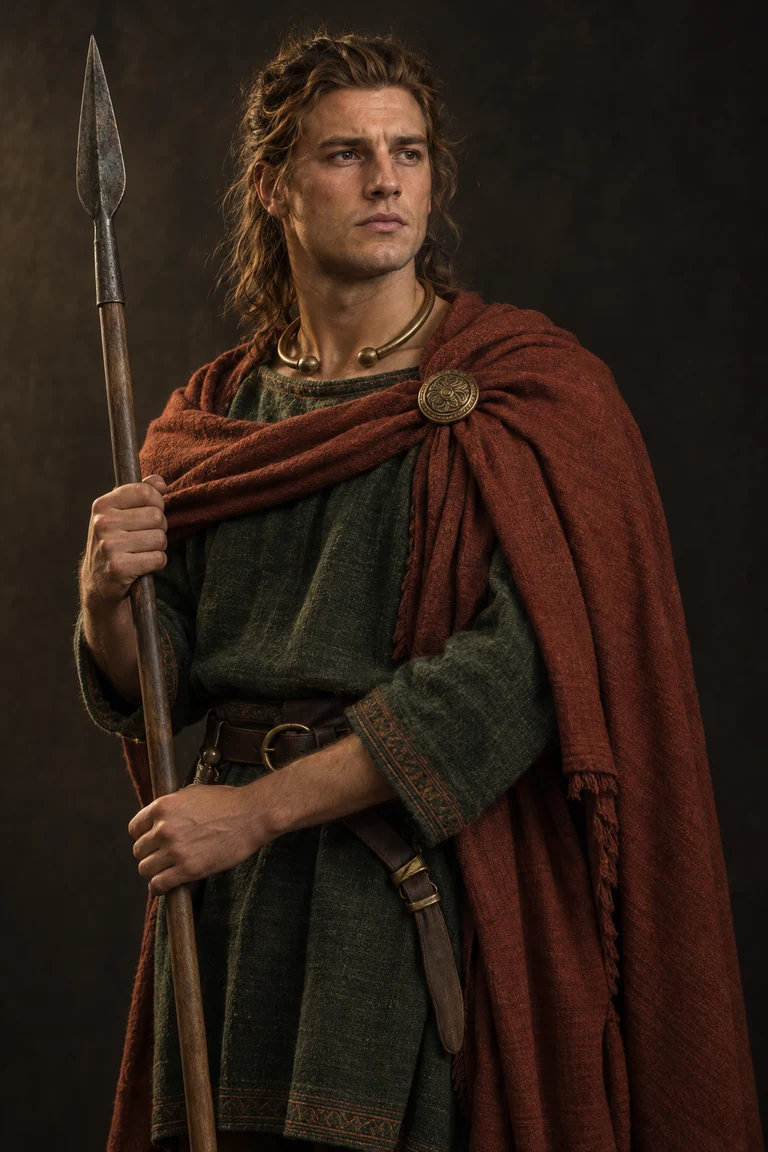
An alternate history game of Vercingetorix's war against Caesar
The Fires of Gaul is a free, browser-based alternate history game from HistoryForge. You play the Gallic side of Julius Caesar's war in 52 BCE, the year Vercingetorix united much of Gaul against Rome. The story follows the real campaign, from burning your own grain to the siege of Alesia, and one hard-earned path lets you change who wins.
How The Fires of Gaul plays
- You play
- The leader of a small Biturigan war band in Vercingetorix's coalition: the Heir to a small estate, or the Scout who knows the district's roads. Your sister Neria is trying to keep the families who follow you alive.
- Length
- About twenty minutes. Three chapters: the scorched-earth retreat near Avaricum, the road from Gergovia to Alesia, and the relief of Alesia.
- Decisions
- Up to sixteen, each between two or three concrete choices. Your band's readiness and the people you kept or lost carry forward, and some options only open if you prepared for them earlier.
- Endings
- Several. Some follow the real outcome at Alesia, one earned path breaks the siege, and you can die or be taken prisoner along the way. Each run ends with a fate card you can share, and you can replay the same revolt with different choices.
Gaul before the conquest
Caesar opens his account of the war by dividing all Gaul into three parts: the Belgae, the Aquitani and the people who called themselves Celts. The tidy division is his. On the ground Gaul was a patchwork of independent peoples with their own councils and rivalries: the Arverni of the Massif Central, the Aedui, Rome's allies for generations, the Carnutes around Cenabum (Orléans), and the Bituriges, whose chief town Avaricum lies under modern Bourges. The Fires of Gaul puts you among the Bituriges.
In his sixth book Caesar describes a society led by druids and a warrior aristocracy, with ordinary people treated, he claims, almost as slaves. The druids judged disputes, presided over sacrifices and met once a year in the land of the Carnutes, which Gauls reckoned the centre of the country. Their pupils might train for twenty years, learning verses by heart, because the druids would not write their teaching down, though Gauls kept ordinary accounts in Greek letters. Archaeology adds what Caesar leaves out: fortified towns, called oppida, with workshops and mints, like the Aeduan hilltop town of Bibracte, and broken Italian wine jars in vast numbers. Diodorus Siculus claims a merchant could trade one jar of wine for a slave.
Vercingetorix and the great revolt of 52 BCE
In January 52 BCE the politician Clodius was murdered in Rome, and the Gauls hoped the crisis would keep Caesar, wintering in northern Italy, away from his legions. The Carnutes struck first, killing the Roman traders at Cenabum. Caesar says the news was shouted from field to field, so that what happened at sunrise was known among the Arverni, about 160 miles away, before the night was far gone.
Among the Arverni a young noble, Vercingetorix, son of Celtillus, called his followers to arms. His father had held the leading position in all Gaul and had been killed by his own people for aiming at kingship. Vercingetorix's uncle Gobannitio threw him out of Gergovia, so he raised an army of the poor and the outcast, came back, expelled his opponents and was hailed as king. Caesar describes a coalition held together by hostages, quotas of men and weapons, and punishment: death by fire for serious offences, a man sent home with his ears cut off for lesser ones. Arvernian gold coins carrying his name survive.
Scorched earth and the siege of Avaricum
Caesar says more than twenty towns of the Bituriges were burned in a single day. The strategy hurt him more than his victory suggests: at Avaricum his army went days without grain, living on cattle driven in from far away, and Caesar admits he offered to raise the siege. His soldiers, he says, refused.
The siege was an engineering contest. The legions built a ramp 330 feet broad and 80 feet high toward the wall; the Bituriges, who worked large iron mines, tunnelled under it. Caesar describes their wall in detail: timber beams packed with earth and faced with stone, so stone resisted fire and timber resisted the ram. Archaeologists call it the murus gallicus and find it at oppida across Gaul. The town fell when the Romans attacked in a rainstorm while the guards were careless. Vercingetorix had argued against defending it, and Caesar notes that his authority grew after the loss.
Gergovia: Caesar's real defeat
Caesar sent four legions north and led six against Gergovia, the Arvernian hill town near modern Clermont-Ferrand. His own account of the assault is a careful piece of explanation. He says he ordered the recall once his men had taken the Gallic camps on the slope, but the trumpet could not be heard across a valley and the legions pushed on to the wall, where the centurion Lucius Fabius climbed up and was killed. Caesar admits nearly seven hundred soldiers and forty-six centurions lost, then reprimanded his troops for recklessness, turning a defeat into a lesson in discipline. Soon afterwards the Aedui, his oldest allies, joined the revolt and seized his hostages, treasury and spare horses.
Alesia and the surrender
Vercingetorix withdrew to Alesia, a hilltop town of the Mandubii on Mont Auxois in Burgundy, and Caesar dug in around it, fronting his lines with traps his soldiers named: sharpened stakes hidden in pits, called lilies, and hooked iron spikes, called spurs. Excavations ordered by Napoleon III from 1861 to 1865, and a Franco-German programme from 1991 to 1997, traced the Roman works on the ground. Inside, food ran out. The defenders expelled the Mandubii, the people whose town it was, with their wives and children. They begged at the Roman rampart to be taken as slaves and fed; Caesar refused them and does not say what became of them.
The surrender survives in three versions. Caesar's is terse: the chiefs were brought out to him seated before his lines, Vercingetorix was handed over, arms were thrown down. Plutarch, writing about 150 years later, has him put on his finest armour, ride a circle around Caesar, then strip off the armour and sit silent at his feet. Cassius Dio, later still, has him kneel with clasped hands, hoping an old friendship with Caesar would save him. The famous image of the rider and his horse comes from Plutarch, not Caesar.
What happened to Vercingetorix
Caesar kept him in chains for nearly six years while he fought a civil war against Pompey. In 46 BCE Caesar celebrated four triumphs in a month; Suetonius says the Gallic triumph was the first and most splendid, and that on its day the axle of Caesar's chariot broke. Vercingetorix was paraded and then, Dio says, put to death. He was largely forgotten until the nineteenth century, when Napoleon III made him a national hero. The copper statue he raised at Alesia in 1865 declares that a united Gaul, forming a single nation, can defy the universe, a line about France in the 1860s more than the Arverni.
Why the outcome was not inevitable
Knowing the ending makes Alesia look like destiny. Caesar's own account does not read that way: a starving army at Avaricum, a defeat at Gergovia, his oldest allies changing sides by midsummer. Plutarch adds that the Arverni later hung a short sword in a temple, claiming it was taken from Caesar, and that Caesar smiled at it and refused to have it removed. At Alesia the margins were narrow: hired German cavalry, the weeks the relief army took to assemble, how long the food lasted. Caesar's enemies in Rome were waiting to prosecute him. None of this means the coalition would have won the war. It means the result turned on choices made in one season, which is the honest ground for asking what if.
What is real in The Fires of Gaul
The campaign is real: Vercingetorix's coalition, the scorched-earth retreat, the fall of Avaricum, the Gallic victory at Gergovia and the siege of Alesia, where historically the relief attacks failed and Vercingetorix surrendered. Vercingetorix and Caesar are historical. Your Biturigan war leader, your sister Neria, your old mentor Cavaros and his deputy Damos are invented, and so are their actions and fates. One earned branch deliberately departs from the record: the coalition breaks the siege and Caesar withdraws. That did not happen, and the story does not pretend it would have ended Rome's ambitions or guaranteed peace. Along the way the game unlocks short history notes, each with its sources, showing where the story follows the record and where it turns.
Sources
- Caesar · Gallic War VI.11-20, Gallic society and the druids (LacusCurtius)
- Caesar · Gallic War, Book VII (LacusCurtius)
- Plutarch · Life of Caesar 25-27 (LacusCurtius)
- Cassius Dio · Roman History 40.41 (LacusCurtius)
- Cassius Dio · Roman History 43.19 (LacusCurtius)
- Suetonius · Life of Julius Caesar 37 (LacusCurtius)
- Diodorus Siculus · Library of History 5.26 (LacusCurtius)
- MuséoParc Alésia · Archaeology of the siege