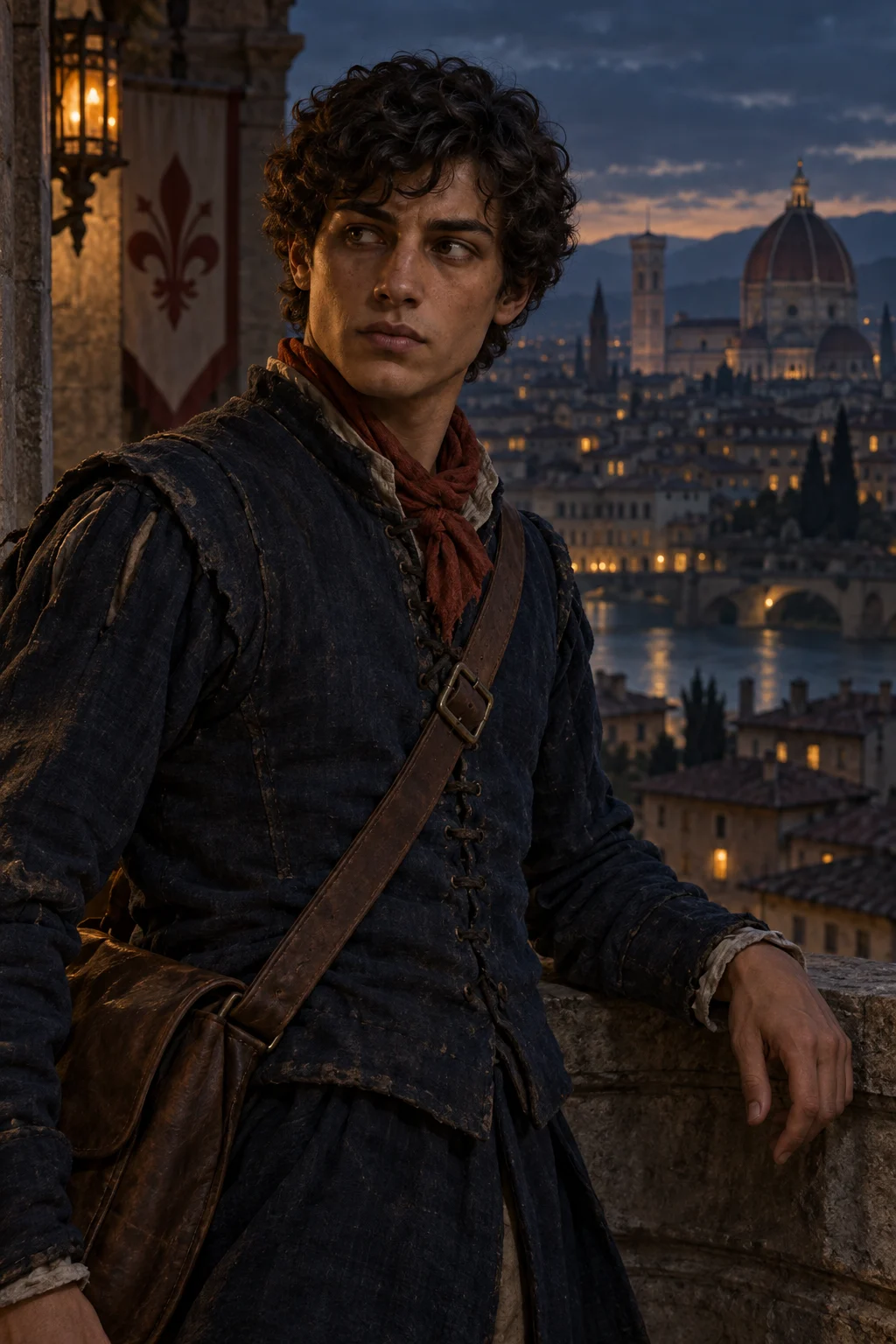
A Renaissance game set in Lorenzo de' Medici's Florence
The Price of a Name is a free, browser-based Renaissance game from HistoryForge. You spend one night in Florence in 1490, the city of Lorenzo de' Medici, working a contract you never wanted: a merchant is holding your brother, and the price of his freedom is another man's life. There is no grinding and no stat sheet. You make choices about whom to trust, what to steal and whom to spare, and each one follows you to dawn.
How The Price of a Name plays
- You play
- A courier who knows the city's roofs and back lanes, or a forger whose hand can make a borrowed name look real. Each has a different edge and a different idea of what saving your brother means.
- Length
- About twenty minutes. Three chapters across one night: the contract, the man on the paper, and the reckoning before dawn.
- Decisions
- Fifteen, five in each chapter, each between two or three concrete choices. Suspicion follows you all night: witnesses and alarms raise it, trusted help gives you room, and if it fills, the watch takes you.
- Endings
- Nine, from leaving Florence at first light to falling from the roofs or being taken before the morning bells. Each run ends with a fate card you can share, and you can replay the same contract with a different conscience.
Florence in 1490
In 1490 Florence was a republic of bankers, guildsmen and wool merchants, and Lorenzo de' Medici, then 41, was its most powerful citizen. He was also a sick man. Gout kept him at Tuscan spas for longer each year, his wife Clarice Orsini had died in 1488, and much of his energy went into his children's futures. In 1487 he married his daughter Maddalena to Franceschetto Cibo, the son of Pope Innocent VIII, and in March 1489 the same pope named Lorenzo's son Giovanni a cardinal at the age of thirteen, an appointment kept secret until 1492.
How Medici power actually worked
On paper Florence was governed by the Signoria: eight priors and a Gonfaloniere of Justice, drawn by lot from bags of eligible names and replaced every two months. The trick was in the bags. Officials called accoppiatori decided whose names went in, and after Cosimo de' Medici's return from exile in 1434 the accoppiatori were reliably Medici friends. Florentines called the resulting circle of trusted families the reggimento, the regime.
Lorenzo tightened the system after 1478. In 1480 an emergency council, a balìa, created the Council of Seventy, which took over the accoppiatori's work of choosing the government and had to approve all legislation. Its first thirty members were Medici partisans, who then co-opted forty more. Its renewals in 1485 and again in 1490 met open resistance. Day-to-day order belonged to the Otto di Guardia, the Eight of the Watch, the nearest thing the city had to a police force.
The money behind it all was the Medici bank, founded by Giovanni di Bicci de' Medici in 1397, with branches that had reached from Rome and Venice to Geneva, Bruges and London. By 1490 it was in trouble: the Bruges branch under Tommaso Portinari had lent heavily to Charles the Bold, duke of Burgundy, and the Milan branch closed in 1479 because its loans to the dukes of Milan could not be recovered. The bank did not survive the family's fall in 1494.
The long shadow of the Pazzi conspiracy
Every adult in Florence in 1490 remembered Sunday 26 April 1478, when conspirators backed by the Pazzi family and Pope Sixtus IV killed Lorenzo's brother Giuliano in the cathedral. Machiavelli, writing his Florentine Histories in the 1520s, describes the archbishop of Pisa, Francesco Salviati, hanged from the windows of the government palace with his companions, and Francesco de' Pazzi dragged there naked from his bed to hang beside him. Old Jacopo de' Pazzi, the head of the family, was buried in the family tomb, dug up again "like an excommunicated person", dragged through the streets by the halter he had been hanged with, and thrown into the Arno.
The pope answered with the church's weapons. On 1 June 1478 Sixtus IV excommunicated Lorenzo, his supporters and the government, on 20 June he placed the whole city under interdict, and King Ferrante of Naples made war on Florence. Lorenzo ended the war by going to Naples himself by sea, a gamble that kept him at Ferrante's court from 18 December 1479 to 27 February 1480. The excommunication was lifted only in December 1480, after the Ottoman capture of Otranto gave the pope larger worries. The surviving Pazzi spent the decade imprisoned or in exile, their property confiscated.
Savonarola's return
The Dominican friar Girolamo Savonarola, born in Ferrara in 1452, had already spent five years at the convent of San Marco, from 1482 to 1487, without making much of a mark. He came back for good in the late spring of 1490, and the pressure that brought him came from Lorenzo de' Medici, probably on the advice of the philosopher Giovanni Pico della Mirandola. On 1 August 1490 he began lecturing on the Book of Revelation at San Marco. By Lent 1491 the crowds had moved his sermons into the cathedral.
In 1491 the friars elected him prior of San Marco, a convent Cosimo de' Medici had paid to rebuild. His early biographers say he refused the customary visit of homage to Lorenzo as the house's patron, declaring that he owed his election to God alone. By early 1492 the apothecary Luca Landucci, whose diary runs from 1450 to 1516, reports a sermon in the cathedral every morning, with fifteen thousand people listening.
Artists and workshops in 1490
Florentine art was made in workshops, botteghe, run like small businesses. In 1490 Domenico Ghirlandaio's was the busiest in the city, and that year it finished the frescoes of the main chapel of Santa Maria Novella for the banker Giovanni Tornabuoni, Lorenzo's uncle. The scenes are crowded with recognisable Florentines in the clothes of the day, and one group of four men is usually identified as scholars of Lorenzo's circle, among them Marsilio Ficino and Angelo Poliziano.
An apprentice did not pay to learn. Vasari copies out the entry in which Lodovico Buonarroti placed his son Michelangelo with Domenico and David Ghirlandaio on 1 April 1488 for three years, with the masters paying the boy twenty-four florins over the term. About a year later, Vasari says, Lorenzo asked Ghirlandaio for promising pupils to train as sculptors in the Medici garden near San Marco, where the elderly Bertoldo di Giovanni, a pupil of Donatello, looked after a collection of ancient statues. Michelangelo, about fifteen, went to live in the Medici house and ate at Lorenzo's table until 1492.
Vasari's garden stories, such as the marble faun whose tooth Michelangelo chipped out after Lorenzo teased him, were written decades later by a man who worked for the Medici dukes, and historians are cautious about treating the garden as a formal academy. The broken nose is better attested: the fellow pupil Pietro Torrigiano later boasted to Benvenuto Cellini of the punch that gave it to him.
What came after: 1492 and 1494
Lorenzo did not see the decade out. On the night of 5 April 1492 lightning struck the lantern on top of Brunelleschi's dome, and Landucci describes a marble niche crashing through the cathedral roof onto the benches set out for the morning sermon. Three days later, on 8 April, Lorenzo died at the Medici villa at Careggi, aged 43. Machiavelli lists the lightning first among the "many evident tokens" that "the greatest devastation would shortly ensue".
What Savonarola said at Lorenzo's deathbed is one of the period's long arguments. Poliziano, who was there, wrote that the friar urged him to hold to the faith, amend his life and meet death bravely, and that Lorenzo asked for his blessing. Savonarola's followers later told a sterner story, in which he demanded that Lorenzo restore Florence's liberty and Lorenzo refused. Pasquale Villari defended the friars' version in the nineteenth century. Many historians since have read it as a story shaped by Savonarola's later politics.
Lorenzo's son Piero lasted two years. When Charles VIII of France marched into Italy in 1494, Piero went to the French camp and handed over the fortresses of Sarzana and Pietrasanta and the port of Pisa. Florence expelled the Medici on 9 November 1494, set up a Great Council modelled on Venice's, and listened to Savonarola until he was hanged and burned in the Piazza della Signoria on 23 May 1498. The Medici came back in 1512, and the next year Giovanni, the boy cardinal of 1489, became Pope Leo X.
What is real in The Price of a Name
The city is real: Florence in 1490, a republic that kept its councils and elections while Lorenzo de' Medici, alive and ailing, shaped much of what they decided. The story is not. The contract and the crime behind it are invented, and so are the merchant Aldo Vescari, the target Tommaso Rinaldi, your brother Paolo and the people you meet along the way. Nothing in the game reconstructs a real assassination or portrays a historical order of killers, and Suspicion is a game measure, not a historical one. As you play, the game unlocks short history notes, each with its sources, about the real world behind the story.
Sources
- Niccolò Machiavelli · History of Florence, Book VIII (Project Gutenberg)
- Luca Landucci · A Florentine Diary from 1450 to 1516, trans. A. de Rosen Jervis, 1927 (Internet Archive)
- Giorgio Vasari · Lives, Vol. 9: Michelagnolo Buonarroti (Project Gutenberg)
- Pasquale Villari · Life and Times of Girolamo Savonarola, trans. Linda Villari (Internet Archive)
- Ingeborg Walter · Medici, Lorenzo de' · Dizionario Biografico degli Italiani (Treccani)
- Stefano Dall'Aglio · Savonarola, Girolamo · Dizionario Biografico degli Italiani (Treccani)