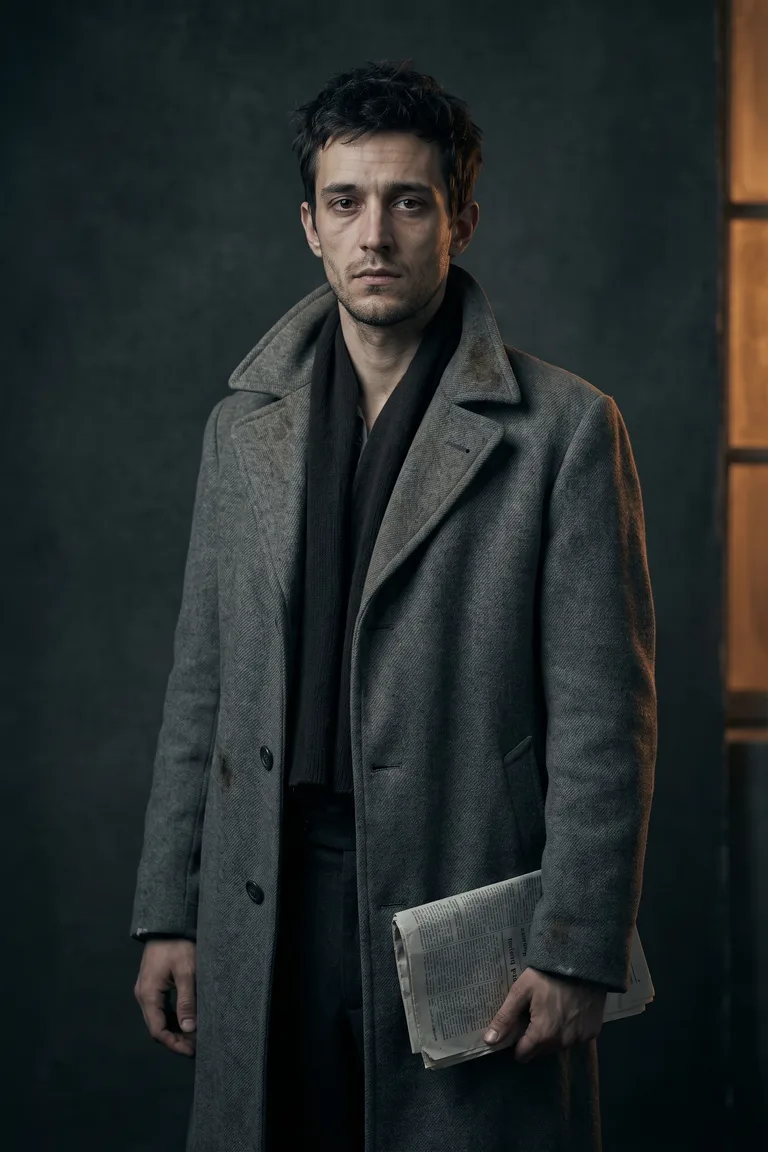
A French Resistance game set in occupied Paris, 1944
One Wrong Word is a free, browser-based WW2 French Resistance game from HistoryForge. It is not a shooter or a strategy game. You play one evening in occupied Paris in May 1944, a few weeks before the Normandy landings, as a courier carrying what a clandestine radio operator needs to go on the air. Every choice trades time before the curfew against how much the watchers have written down about you.
How One Wrong Word plays
- You play
- A Resistance courier. Your sister Sylvie is the network's wireless operator, and tonight her quartz crystals and schedule sheet travel across Paris in your coat lining.
- Length
- About ten minutes. Two chapters: the pickup at dusk, then the crossing of the city during the transmission window.
- Decisions
- Seven, each between two or three concrete choices. Two meters carry forward: Suspicion, what the night's watchers have noted about you, and the Curfew, the quarter-hours left before the bell.
- Endings
- Several, from getting the message out with both of you clear to arrest at a checkpoint or worse. Each run ends with a fate card you can share, and you can replay the same evening by a different route.
Daily life in occupied Paris
German troops entered Paris on 14 June 1940, the day after it was declared an open city. Clocks were moved to Berlin time, German signposts went up at the crossroads, and the occupiers took over grand homes and the best restaurants. Rationing of bread, pasta and sugar began in September 1940 and spread to almost everything else: fuel, clothing, shoes, tobacco. Ration cards sorted Parisians into eleven categories by age and work, and the official ration did not feed a family. The gap was filled by parcels from relatives in the countryside, by hours in queues outside nearly empty shops, and by a black market that grew quickly.
Papers ruled movement. From late 1940 Vichy required adults to carry a French identity card, and German permits, the Ausweis, governed everything from crossing the demarcation line to being out after curfew. The curfew hour itself changed over four years, and after attacks on German soldiers the command repeatedly pulled it earlier as a collective punishment. From February 1943 the Service du travail obligatoire, the compulsory labour draft, sent young French men to work in Germany. Any man of draft age on the street became someone to question, and many of those who refused went into hiding or into the rural maquis.
For Jewish Parisians the occupation was persecution from the start. A German order of July 1942 allowed Jews into shops only between three and five in the afternoon, and on 16 and 17 July 1942 French police arrested some 13,000 Jews in the city in the Vel d'Hiv roundup. Most deportation trains left from Drancy, a transit camp on the edge of Paris.
How resistance networks actually worked
Resistance in Paris began small and scattered. On 11 November 1940 several thousand people, most of them school and university students, marched to the Étoile in defiance of a ban and were broken up by force. Two kinds of organisation grew from there. Movements such as Libération-Nord, the Organisation civile et militaire and Défense de la France printed clandestine newspapers and recruited. Networks, réseaux, did specific jobs for London: gathering intelligence, running escape lines for Allied airmen, or receiving agents and weapons for de Gaulle's intelligence service, the BCRA, or for Britain's Special Operations Executive.
Survival depended on compartmentalisation, which the French called cloisonnement. A member knew a handful of others by cover names, met them through fixed letterboxes and safe addresses, and was not supposed to know more than the job required. Couriers, agents de liaison, carried messages, money and equipment between cells on foot, by bicycle and by métro, and many of them were young women, who were less likely to be stopped. The usual rule was that anyone arrested should try to hold out for forty-eight hours, long enough for everyone they knew to move.
The weak point was always people. Jean Moulin, sent by de Gaulle to unite the movements, chaired the first meeting of the National Council of the Resistance at 48 rue du Four in Paris on 27 May 1943. Less than a month later, on 21 June, he was arrested with other leaders at a house in Caluire, near Lyon, after the meeting had been betrayed, and he died in German custody in July. On 1 February 1944 the armed groups, from the Gaullist Armée secrète to the Communist Francs-tireurs et partisans, were merged into the French Forces of the Interior, the FFI, under General Koenig in London.
The Gestapo, the SD and the French Milice
Parisians said "the Gestapo" for the whole German police apparatus. Strictly, the men who hunted the Resistance were the Sicherheitspolizei and SD under Helmut Knochen, answerable from May 1942 to the Higher SS and Police Leader Carl Oberg. Their headquarters at 84 avenue Foch became the most feared address in the city. The Resistance leader Pierre Brossolette, caught in a routine check in Brittany in February 1944 and identified in March, was brought there on 19 March. On 22 March he threw himself from a fifth-floor window rather than risk talking, and died that night. Military intelligence, the Abwehr, worked from the Hôtel Lutetia, and French gangsters in German pay ran their own operation from the rue Lauriston.
The French state did much of the work too. Agreements in 1942 and 1943 between Oberg and the Vichy police chief René Bousquet tied French police to German operations, and the Prefecture of Police's Brigades spéciales tailed resisters for weeks before arresting them. Their work broke the FTP-MOI, a group of immigrant partisans, in late 1943. A German military court condemned twenty-three of its members on 19 February 1944, and the occupiers covered Paris with the Red Poster to brand them foreign terrorists. The twenty-two men were shot at Mont-Valérien, where hundreds of condemned prisoners and hostages were executed during the occupation.
The Milice française was created by Vichy in January 1943, with Pierre Laval as its official head and Joseph Darnand as its real leader. It began in the southern zone. In early 1944 Darnand took charge of Vichy's forces of order and the Milice moved north, into Paris, which is why a courier in the spring of 1944 could meet Frenchmen in Milice uniform at a checkpoint. In June and July 1944 miliciens murdered the former ministers Jean Zay and Georges Mandel.
The summer of 1944 and the liberation of Paris
The Allies landed in Normandy on 6 June 1944, and coded messages on the BBC told resistance groups across France to begin sabotage. Paris waited. As the Allied armies broke out in August, the city's workers struck one after another, the railwaymen first and then, on 15 August, the police. The same day a final train of prisoners left Pantin station for Buchenwald and Ravensbrück.
On 19 August police occupied the Préfecture de police and the uprising began. Henri Tanguy, known as Colonel Rol, regional commander of the FFI since 1 June, directed it from 20 August from an underground command post beneath place Denfert-Rochereau, and on 21 and 22 August he ordered barricades across the city. A truce brokered with the help of the Swedish consul Raoul Nordling held only in part. Eisenhower had planned to bypass Paris, but under pressure from de Gaulle he let General Leclerc's 2nd Armored Division go. Its first detachment reached the Hôtel de Ville on the night of 24 August. On 25 August Leclerc entered by the Porte d'Orléans and General Dietrich von Choltitz signed the surrender, with Rol countersigning. De Gaulle walked down the Champs-Élysées the next day.
Two myths grew from that week. Hitler did order that Paris fall to the Allies only as a field of ruins, and after the war Choltitz presented himself as the general who disobeyed and saved the city, a story made famous by the book and film Is Paris Burning? Historians are more cautious: his forces were thin, the uprising and the approaching army narrowed his options, and his memoir was written by a man with every reason to look good. The second myth was of a nation of resisters. Historians since Robert Paxton have described something harder: an active resistance that was a minority, a collaboration that reached deep into the French state, and a majority trying to get through the day.
What is real in One Wrong Word
The night is invented and the world around it is not. The courier, Sylvie, Henri, Marthe, the man in the grey coat and their network are fictional, and the game does not claim the roster or route of any documented réseau. The Milice at the métro barriers, the German direction-finding vans, the curfew, the labour draft and the trade in sold names are real features of Paris in May 1944. Suspicion and the Curfew are game mechanics, not historical measurements. The debrief on your fate card remembers one real person, the SOE wireless operator Noor Inayat Khan, and the history notes you unlock during play explain the rest, each with its sources.
Sources
- Paris is hungry, Paris is cold · Paris 1940-1944, the daily routine of Parisians under the Occupation (City of Paris)
- The German presence · Paris 1940-1944 (City of Paris)
- Multiple resistances · Paris 1940-1944 (City of Paris)
- Cracking down · Paris 1940-1944 (City of Paris)
- Jean Moulin · Musée de l'Ordre de la Libération
- Pierre Brossolette · Musée de l'Ordre de la Libération
- Henri Rol-Tanguy · Musée de l'Ordre de la Libération
- France · Holocaust Encyclopedia, United States Holocaust Memorial Museum