A Great Fire of London game: survive September 1666
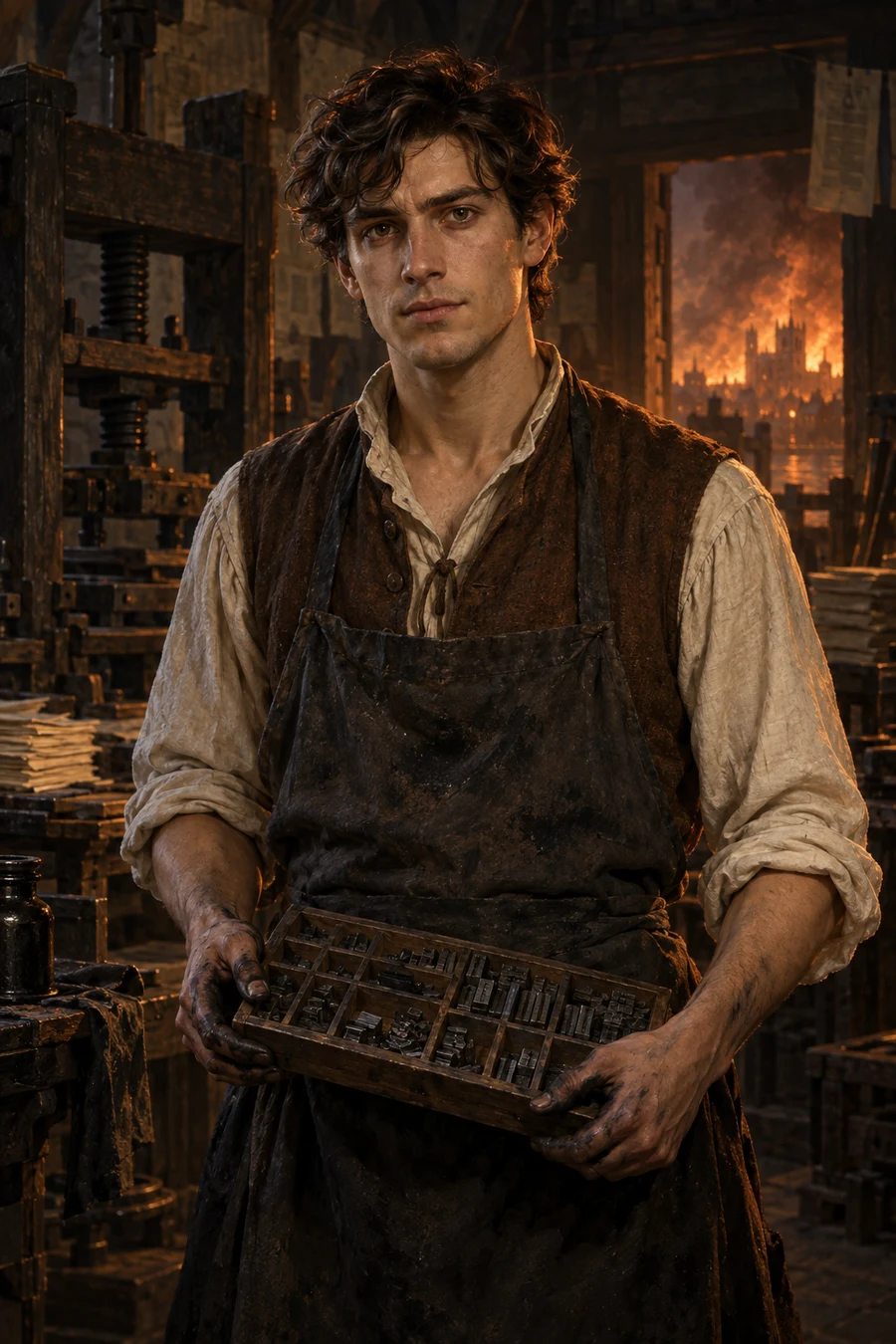
When London Burned is a free, browser-based Great Fire of London game from HistoryForge. You wake above a printing workshop near Thames Street in the small hours of 2 September 1666, with the fire already in the street and your younger sister Elsie beside you. It is an illustrated story of choices written for teens and adults, not a classroom activity: you decide what to carry, which way to run, who to help, and how to earn a living once your street is gone.
How When London Burned plays
- You play
- Either the apprentice of Rowan, a printer, who knows the back lanes from paper rounds, or a Thames waterman given a bed in his workshop for the night. Either way, Elsie is with you.
- Length
- About twenty minutes. Three chapters: escaping the fire on Sunday morning, finding a place for the night in the days that follow, and rebuilding a life several weeks later.
- Decisions
- Eighteen, mostly between two or three concrete choices. At one crowded passage you can write your own plan instead. Your strength and supplies carry forward, and if your strength runs out the story ends there.
- Endings
- Several, from leaving London for a new start to working your old trade again, or not getting out of the lanes at all. Each run ends with a fate card you can share, and you can replay as another life in the same fire.
How the Great Fire started on Pudding Lane
The fire began a little after midnight on Sunday 2 September 1666 in the bakehouse of Thomas Farriner, whom Pepys calls the King's baker. Farriner insisted he had checked his ovens before bed, and nobody knows for certain what lit it. His household escaped through an upstairs window; his maidservant did not, and she is usually counted as the fire's first victim.
Pudding Lane ran downhill from Eastcheap to the river, though later property surveys put the bakehouse a little east of the lane itself: strictly, the fire began just off Pudding Lane.
Samuel Pepys's maid Jane woke him at about three in the morning to look at it. He judged it far enough off and went back to bed. By seven he heard that some three hundred houses had burned overnight and that the fire was running down Fish Street toward London Bridge.
Four days of fire, 2 to 6 September 1666
On Sunday the fire spread west along the waterfront and into the houses at the north end of London Bridge. It did not cross to Southwark, largely because an earlier fire in 1633 had left a gap in the buildings on the bridge. On Monday it pushed north into the commercial heart of the City, and the Royal Exchange burned.
Tuesday was the worst day. The fire crossed the Fleet, reached the Inner Temple, and that night took Old St Paul's Cathedral, where wooden scaffolding from an unfinished repair helped it catch. The wind dropped late on Tuesday, and by Wednesday afternoon the fire was being held. The last serious outbreaks were put out on Thursday. Most of the walled City was gone, including 87 parish churches, the Guildhall and dozens of the livery companies' halls.
Why it spread: drought, wind and a hesitant Lord Mayor
Contemporaries agreed about the weather. On the first morning Pepys wrote that after so long a drought everything was proving combustible, "even the very stones of churches", with the wind "mighty high and driving it into the City". John Evelyn blamed "a long set of fair and warm weather" that had "even ignited the air". The wind held from the east, pushing the flames from the river into street after street of timber-framed houses.
The first hours mattered most, and they were lost. The usual remedy for a London fire was to pull down the houses in its path, but whoever ordered a house destroyed could be held responsible for the cost, and the Lord Mayor, Sir Thomas Bludworth, hesitated. An anonymous letter written soon after records him dismissing the blaze with the remark that a woman might piss it out. The line is often credited to Pepys, but it is not in his diary. What Pepys did record is Bludworth later that Sunday in Cannon Street, "like a man spent", crying that people would not obey him and that the fire overtook the demolitions "faster than we can do it".
Evelyn was blunter. Seamen, he wrote, had proposed blowing up houses "early enough to have saved near the whole city", but "some tenacious and avaricious men, aldermen, etc." refused, because their own houses would have gone first.
Fighting the fire: hooks, buckets and gunpowder
London had no fire brigade. Each parish was expected to keep leather buckets, ladders, axes and long hooks for dragging down timber walls, and some had brass fire squirts, hand syringes that threw one jet of water at a time. Against a fire this size they achieved little, and on the first day Pepys saw "nobody, to my sight, endeavouring to quench it".
On Monday Charles II put his brother James, Duke of York, in charge. Fire posts were set up around the edge of the blaze, manned by courtiers and constables, and the King and the Duke were seen working among the crowds. Evelyn wrote that they were "even laboring in person". The decisive change came on Tuesday, when gunpowder was used to blow gaps too wide for the fire to jump. Pepys, fearing for the Navy Office, proposed bringing up workmen from the royal dockyards at Woolwich and Deptford. Blowing up houses near the Tower, he noted, "did frighten people more than anything, but it stopped the fire where it was done".
Pepys and Evelyn, the great eyewitnesses
Pepys, a senior official at the Navy Office, kept a private diary in shorthand, and neither his diary nor Evelyn's was published until the nineteenth century. His fire entries are vivid because they are personal. He takes a boat under the bridge, watches pigeons that "hovered about the windows and balconys till they were, some of them burned", carries the King's order to the Lord Mayor, and on 4 September digs a pit in his garden with Sir William Penn for their wine and, famously, his Parmesan cheese.
Evelyn, a courtier and writer, walked through the burning City and then its ruins. He saw "the stones of Paul's" fly "like grenados" and melted lead "running down the streets in a stream". He recorded that the booksellers' stock, carried into St Faith's church beneath St Paul's for safety, burned for a week after the roof fell in. On 7 September he crossed from Whitehall to London Bridge over rubble so hot that it "burnt the soles of my shoes".
How many people died in the Great Fire?
The official record lists only a handful of deaths, six in the figure most often quoted, and the London Museum notes that fewer than ten are recorded. That is a minimum, not a count. The poor, lodgers and people without a settled parish were badly recorded even in ordinary weeks, nobody searched the rubble systematically, and the fire disrupted the weekly Bills of Mortality that tracked burials.
In 2001 the writer Neil Hanson argued that the true toll was far higher. Many historians remain unconvinced, pointing out that the fire spread over days rather than minutes and most people had time to get out. The real figure is simply unknown.
Robert Hubert and the hunt for a culprit
England was at war with the Dutch and with France, and only weeks earlier an English fleet had burned the Dutch town of West-Terschelling. Many Londoners assumed the fire was revenge. By 5 September Pepys was noting "discourse now begun, that there is plot in it, and that the French had done it", and foreigners were attacked in the streets.
The scapegoat was Robert Hubert, the son of a watchmaker from Rouen, who confessed that he had pushed a fire grenade through the bakery's window. Farriner said the bakehouse had no windows, and the captain of the ship that brought Hubert from Sweden later testified that he reached England two days after the fire began. The Lord Chancellor, Clarendon, called him a "poor distracted wretch, weary of his life". Hubert was hanged at Tyburn on 27 October 1666. A parliamentary inquiry heard a stream of accusations and concluded that the fire was an accident.
Rebuilding London and the Monument
Within days, Christopher Wren and John Evelyn each put a plan for a new city of broad, straight streets before the King. Neither was used: owners wanted to rebuild on their own plots, and London went back up largely on its medieval street plan. The Rebuilding Act of February 1667 set standard house types for different kinds of street, paid for public buildings with a new duty on coal shipped into London, and ordered a yearly day of public fasting. A special Fire Court settled disputes between landlords and tenants over who should pay to rebuild.
Wren's office went on to rebuild 51 City churches and a new St Paul's, begun in 1675. The same Act ordered "a Columne or Pillar of Brase or Stone" near the spot where the fire began. Wren and Robert Hooke designed it, it went up between 1671 and 1677, and it stands 202 feet tall, 202 feet from the site of Farriner's bakery. In 1681, during the anti-Catholic panic of the Popish Plot, a line was added to its inscription blaming the fire on Catholics. It was not chiselled off for good until 1830.
What is real in When London Burned
The setting is real: the fire breaking out in a Pudding Lane bakery before dawn on Sunday 2 September 1666, four days of burning, and Londoners escaping with whatever they could carry, by boat on the Thames or on foot toward the open fields. The people are not. Your character, your sister Elsie, Rowan the printer and everyone you bargain with or help along the way are invented, and so are the routes, fares and offers of work. Strength and supplies are game measures, not historical survival odds, and nobody in the story can stop the fire or save the city. Along the way the game unlocks short history notes, each with its sources, that explain what the story is built on.
Sources
- Samuel Pepys · Diary, 2 September 1666
- Samuel Pepys · Diary, 4 September 1666
- John Evelyn · Diary, vol. 2 (Project Gutenberg)
- An Act for rebuilding the City of London, 1666 (British History Online)
- British Library · Robert Hubert and the Great Fire of London
- London Museum · The Great Fire of London
- The Monument · History