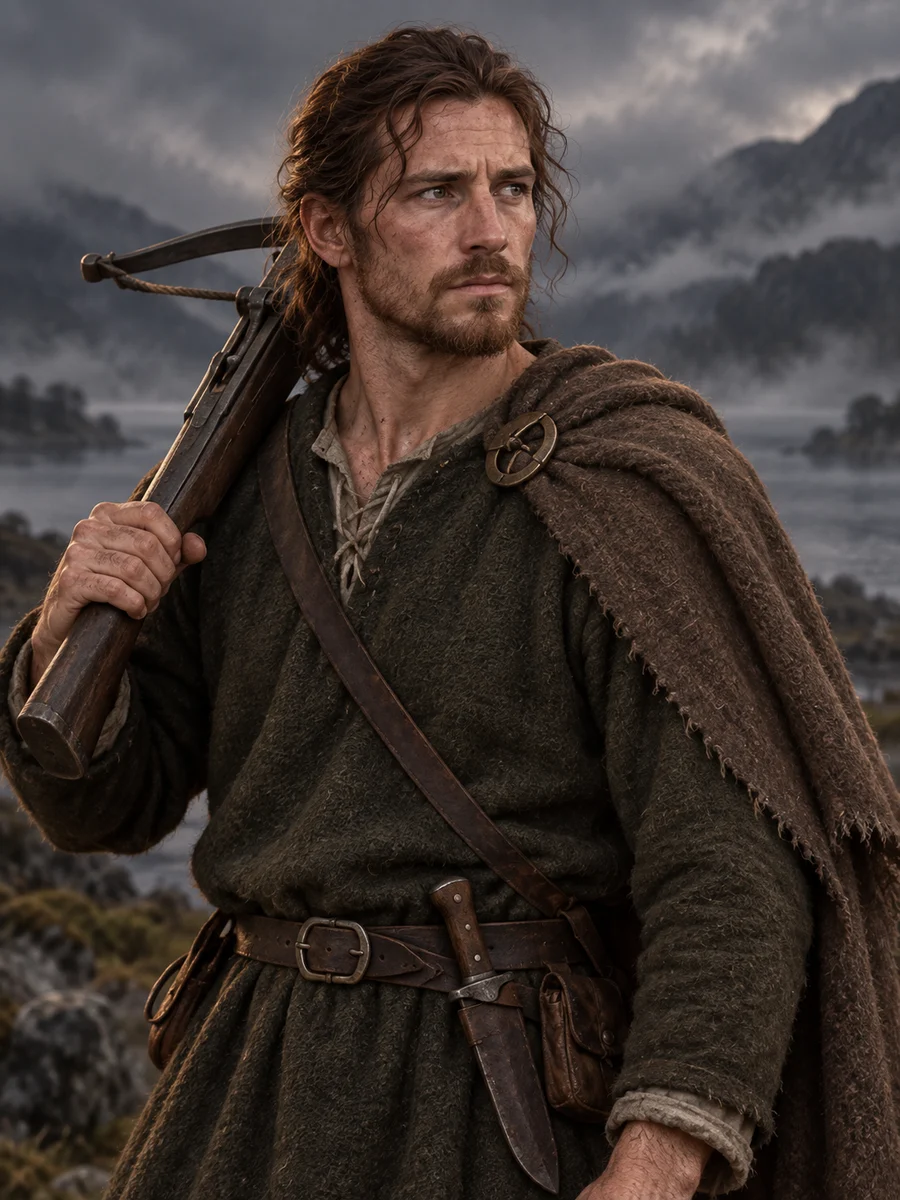
A Scottish folk horror story game set beside a Highland loch
The Black Loch is a free, browser-based horror story game from HistoryForge, set in the Scottish Highlands around 1300, during the Wars of Independence. You have one night to carry your wounded brother past a loch and home, with English soldiers behind you and Highland folklore waiting in the dark. There is no combat system and no inventory screen: you make eight decisions, and each one changes who comes home.
How The Black Loch plays
- You play
- A young cattle keeper who knows every track around the loch. You have just cut your younger brother, Ewan, out of an English prisoner column, and his injured leg will not carry him.
- Your goal
- Get Ewan home before Harwood, the English sergeant hunting you, takes you both back. Home lies beyond the loch, up a path you learned beside your father.
- Length
- About fifteen minutes. Three chapters: the way home at dusk, a roof for the night, and the last thing you owe.
- Decisions
- Eight, each between two or three concrete choices. A Condition meter tracks the strength you have left: carrying Ewan and fighting spend it, warmth gives a little back, and injuries last.
- Endings
- Eleven. Some bring Ewan home, others end in recapture or death, and every run closes with a fate card you can share. Replay on the same shore and take another way home.
The Highlands around 1300
In 1300 the Highlands were Gaelic-speaking country, run less by royal officials than by great lords and the kindreds who followed them. The earls of Ross held much of the north, the Comyn family held Badenoch and Lochaber, and on the western seaboard the MacDougalls of Lorn and the MacDonalds of Islay traced their descent from Somerled, the twelfth-century ruler of Argyll and the Isles. The clans of later legend were still taking shape. What mattered was kin, the lord you owed service to, and the cattle you owned.
Cattle were the measure of wealth. Dues to a lord were often paid in livestock and produce, and raiding a neighbour's herd was a recognised, if dangerous, part of life. In summer, families drove their animals up to hill pastures and lived for weeks in shielings, small huts of turf and stone, while oats and barley grew on the low ground. Most detailed descriptions of shieling life come from much later centuries, but the practice lasted so long that on Lewis it was still followed in the twentieth century.
The war reached the north quickly. The English took Urquhart Castle on Loch Ness in 1296. In May 1297 Andrew Murray, escaped from captivity at Chester, raised men at Avoch on the Black Isle. His first move was a failed night attack on Urquhart; he went on to take castles across Moray before joining William Wallace to win at Stirling Bridge on 11 September 1297, and he died of his wounds later that year. Urquhart changed hands again in the years that followed, and after Robert Bruce made himself king in 1306 it came under his control. In the west, Bruce's war was also a feud: the MacDougalls of Lorn, kin by marriage to the Comyns, beat him at Dalry in 1306 and were broken by him at the Pass of Brander around 1308.
Water-horses, water-bulls and other loch beasts
Highland Gaelic tradition filled its lochs with animals. The best known is the each-uisge, literally 'water-horse', a dangerous creature said to live in lonely freshwater lochs. In the tales collected by John Gregorson Campbell it could also come ashore as a handsome young man, betrayed only by sand or green water weed in his hair. A herding girl finds a sleeping stranger with his head in her lap, notices horse hooves, and slips away: Campbell calls this story known over the whole Highlands, and in his day it was placed at Loch Meudaidh in Durness, where the girl's descendants were still pointed out, and at Loch Assapol on Mull.
Not every loch beast was hostile. The tarbh-uisge, or water-bull, was said to be harmless. It lowed by the water at night and mixed with the farmers' cattle, and calves born with short, clipped-looking ears were said to be its offspring. Skye had the biasd na srogaig, a gangling one-horned loch beast whose main use, Campbell suspected, was keeping children quiet. Loch Awe had a twelve-legged beast that could be heard breaking the ice in winter, like a horse according to some and like a huge eel according to others.
The oldest written story of a monster in this landscape is far earlier than any of these, and it is not a horse. Adomnán, abbot of Iona, wrote his Life of Columba around 700 CE. In one chapter Columba, travelling among the Picts, reaches the River Ness as local people are burying a man who had been bitten to death by a water beast while swimming. Columba sends his companion Lugne Mocumin to swim across for a boat. When the beast rises, the saint makes the sign of the cross and orders it back, and it flees. The point of the story is the saint's power over a pagan danger, and Adomnán puts the beast in the river, not the loch. Loch Ness's modern monster dates from newspaper reports in 1933.
How late the folklore was written down
None of the water-horse tales above was written down anywhere near 1300. Gaelic storytelling was oral, and the collectors who preserved it worked in the nineteenth century. John Francis Campbell of Islay published Popular Tales of the West Highlands in 1860. John Gregorson Campbell gathered his material while he was minister of Tiree from 1861 to 1891, and his Superstitions of the Highlands and Islands of Scotland appeared after his death, in 1900. What they wrote down had already passed through many generations of retelling.
The Scots word kelpie is a good measure of the gap. The Dictionaries of the Scots Language give its earliest literary use as a line by the poet William Collins, dated 1747 and printed in 1789: 'Drowned by the Kelpie's wrath.' Robert Burns has 'water-kelpies haunt the foord' in his poem to the Deil of 1786. The only older trace is a place name, Kelpie hoall, recorded in Kirkcudbrightshire in 1674. The word itself probably comes from Gaelic cailpeach or colpach, a bullock or colt.
That does not mean the beliefs were invented late. Water-horse stories are found in Ireland as well as Scotland, and a saint's life written around 700 CE already treats a beast in the Ness as something local people had reason to fear. But the specific names, places and plots in the tales are nineteenth-century evidence. A story set in 1300 can borrow them, as The Black Loch does, without claiming that anyone in 1300 told them in exactly that form.
The church and folk belief side by side
In 1300 the Highlands were thoroughly Christian. The dioceses of Moray, Ross, Argyll and the Isles had bishops, parishes had priests, and the great local saints were the missionaries of the early Gaelic church: Columba of Iona, and Maelrubha, who crossed from Ireland in 671 CE and founded the church at Applecross two years later. Christian practice and older habits of mind were not neatly separated, and the clearest evidence for that comes, again, from later records.
In September 1656 the Presbytery of Dingwall met at Applecross and recorded what it called abominable and heathenish practices. People there sacrificed bulls on 25 August, the day they believed was dedicated to 'St. Mourie'. They walked around ruined chapels, adored wells, and tested whether a traveller would come home by trying to put their head into the hole of a round stone. In Gairloch, people poured milk on hills as offerings. As the records' 1896 editor pointed out, the ministers evidently did not realise that Mourie was Maelrubha, whose name survives in Loch Maree. In 1678 the presbytery summoned Hector Mackenzie of Mellan, his three sons and his grandson for sacrificing a bull on the saint's island in the loch to restore the health of Hector's sick wife.
Martin Martin, a Skye man writing in 1703, recorded more of the same: cow's milk poured on a little hill or a big stone for the spirit called Browny, a cup of ale thrown into the sea at Hallowtide on Lewis for a sea-god called Shony, and fire carried sunwise, deiseal, around a mother and her newborn child to keep evil spirits away. These were Protestant observers describing customs they believed came from a Catholic and pagan past. For a Highlander in 1300, a saint's feast, a holy well and a story about something in the loch probably did not feel like separate belief systems at all.
What is real in The Black Loch
The setting is real: the Highlands during the Wars of Independence, when English garrisons held castles in the north and captivity, military service and divided loyalties ran through the country. The people are not. The cattle keeper, his brother Ewan, the English sergeant Harwood and the empty croft beside the loch are invented, and the escape is a local story placed inside that wider conflict rather than a documented event. The folklore is real but borrowed from later centuries: the story adapts Highland water traditions recorded in the nineteenth century to a setting around 1300. Along the way the game unlocks short history notes, each with its sources, that explain what the story is built on.
Sources
- Adomnán · Life of Columba, Book II, the monster in the River Ness (CELT, University College Cork)
- John Gregorson Campbell · Superstitions of the Highlands and Islands of Scotland (1900), Project Gutenberg
- Dictionaries of the Scots Language · Kelpie
- William Mackay (ed.) · Records of the Presbyteries of Inverness and Dingwall, 1643-1688 (1896), Internet Archive
- Martin Martin · A Description of the Western Islands of Scotland (1703), Ancient and Modern Customs
- Historic Environment Scotland · Urquhart Castle history and stories
- Undiscovered Scotland · Andrew Murray biography