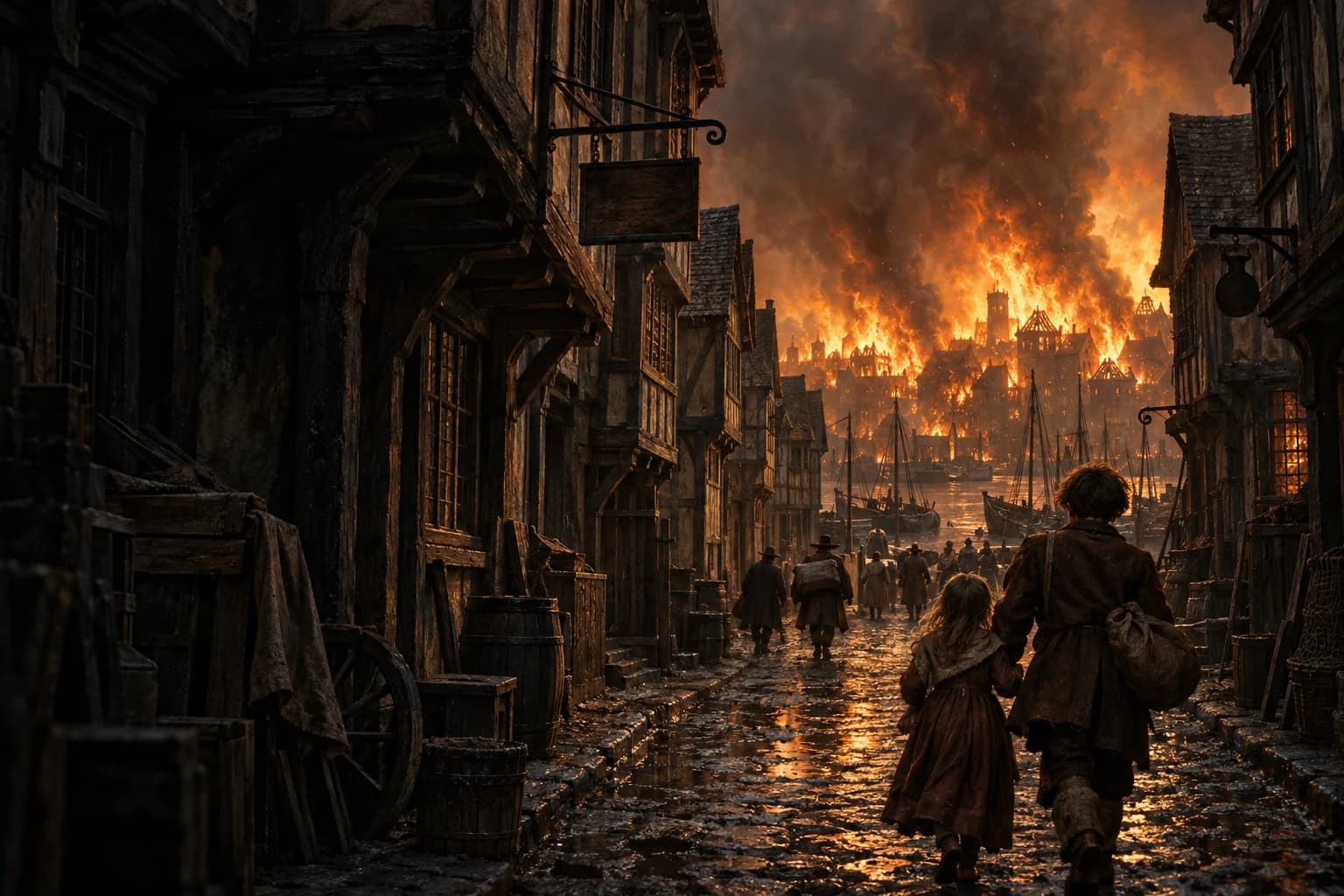
How the Great Fire of London Started
At about one in the morning on Sunday 2 September 1666, fire took hold in a heap of bavins, meaning bundles of brushwood kindling, in the bakehouse of Thomas Farriner. Farriner held the post of Conduct of the King's Bakehouse and supplied ship's biscuit to the Navy, which was then fighting the Dutch. The National Archives still holds his hearth tax return from August 1666: one oven, five hearths.
He escaped across the rooftops through an upstairs window with his daughter Hanna and his journeyman. His maidservant did not get out, and she was the fire's first victim. Research published in 2023 identified the journeyman as Thomas Dagger and, from a letter written that October, established that he was probably the one who found it: his man, the letter says, was woken by the choke of the smoke, and the fire had begun somewhere away from the chimney.
One correction worth making early, because almost every retelling gets it slightly wrong. The bakehouse was not on Pudding Lane. A study of a 1679 property survey places the oven roughly sixty feet east of the lane, beneath what is now the roadway of Monument Street, and the hearth tax lists Farriner in Fish Yard, an alley to the east. It began in a bakehouse just off Pudding Lane.
The Sentence That Cost the City
Fires were ordinary in seventeenth-century London and the remedy was well understood: pull down the houses in the fire's path and starve it of fuel. Someone proposed exactly that within the first two hours, to the Lord Mayor, Sir Thomas Bloodworth, who had arrived before three in the morning.
An eyewitness whose letter survives recorded the answer. Bloodworth, with a pish, said that a woman might piss it out, and neglected the advice. It is the most famous sentence of the whole disaster, and it is almost universally misattributed to Pepys's diary. It is not there. It comes from an anonymous contemporary letter, later printed in a nineteenth-century collection of London documents.
In fairness to a man history has not treated kindly, the hesitation had a rational basis. Whoever tore down a house could be personally liable for rebuilding it without royal authority, and Bloodworth had none at three in the morning. What Pepys did record, later the same day, is the Lord Mayor in Cannon Street, wrung out, crying that he was spent, that people would not obey him, and that the fire was overtaking the demolitions faster than they could be made.
Four Days
Sunday 2 September
Pepys was woken at three by his maid, looked out, decided it was far enough off, and went back to bed. By seven he was hearing that three hundred houses had burned overnight. Before eight the fire reached London Bridge, and here an earlier disaster saved Southwark: a bridge fire in 1633 had destroyed a run of houses that were never rebuilt, and the gap acted as an accidental firebreak.
Pepys took a boat to Whitehall and told the King and the Duke of York that unless houses were pulled down nothing would stop it. Charles II sent him back with an order to spare no houses. It was already several hours too late. That night Pepys watched from the river and described a single arch of fire more than a mile long, and wrote that it made him weep to see it.
Monday 3 September
The Crown took the operation over. Eight fire posts were established and the Duke of York was given command. The fire pushed west along Thames Street and north into the heart of the city, and the Royal Exchange burned. Rumour arrived with it: that the French had done this, or the Dutch, and the militia began spending its time rounding up foreigners instead of fighting the fire.
Tuesday 4 September
The worst day. Cheapside caught at six in the morning and the fire ran from near the Temple in the west almost to the Tower in the east. That evening the demolitions finally became serious, because the Tower garrison began blowing houses up with gunpowder to protect its magazine. Pepys noted that the practice frightened people more than anything else at first, and that it stopped the fire where it was done.
And St Paul's burned. Evelyn's description is the one everyone quotes and it has never been bettered: the stones of Paul's flew like grenades, the melting lead ran down the streets in a stream, and the pavements glowed so red that neither horse nor man could tread on them. Six acres of roof lead melted. The vault collapsed into the crypt below, where the booksellers had stacked their stock for safekeeping, and the books burned for a week.
Wednesday 5 September
Around eleven the previous night the wind had begun to drop, and by noon on Wednesday Evelyn could write that the fury of it was sensibly abating. Pepys found better hopes than he had expected, crediting the blowing up of houses and the help of dockyard workmen sent up from the King's yards. Fresh outbreaks at the Temple, Shoe Lane and Cripplegate were put down by blowing up more houses.
Thursday 6 September
A last significant outbreak at Bishopsgate around five in the morning, which Pepys went out with his men and put out in a little time. It was over. He walked the riverbank and wrote that it was a sad sight to see how the river looked, with no houses nor church near it as far as the Temple, where it stopped.
What Actually Stopped It
Three things together, and the primary sources will not let you credit any one of them alone. Firebreaks at scale, finally made properly once gunpowder was used from Tuesday evening. The east wind dropping late on Tuesday night, which Evelyn treats as decisive. And manpower, especially the dockyard workers shipped up from Woolwich and Deptford by the Navy, who were used to demolition work and took orders.
What was not available was firefighting in any modern sense. There was no fire brigade. Each parish kept equipment in its church: leather buckets, ladders, axes, long hooks for pulling buildings down, and squirts. A fire squirt was a brass syringe that took at least two people to work, held under a gallon, and delivered water in single pushes with no continuous flow. A modern hose puts out more than four hundred litres a minute. Against a firestorm the squirts were ornamental.
Why It Spread
- A long drought. A hard winter had been followed by a hot, dry summer. Pepys wrote that after so long a drought everything was proving combustible, even the very stones of churches.
- A week of east wind. A strong east-north-east wind had been blowing for a week before and continued as long after, driving the flames straight into the city. Evelyn noted it also kindled backwards against itself.
- Timber and jetties. Houses were timber-framed with each storey projecting further over the street than the one below, so that upper floors nearly touched across a lane. The fire crossed streets at roof level. Charles II had issued a proclamation against jetties in 1661 and been ignored.
- The riverside. Thames Street was lined with warehouses of pitch, tar, oil, wine and brandy. Clothworkers' Hall burned for three days and nights on a cellar full of oil.
- The lost first hours. Evelyn is savage about this: seamen proposed firebreaks early enough to have saved nearly the whole city, and aldermen refused because their own houses would have gone first.
One thing you can strike from the list: thatch. Thatched roofs had been banned inside the City since 1189 and the ban was tightened after a fire in 1212. By 1666 almost every roof was tiled, and no contemporary blames thatch. They blame timber.
The Damage, and the Death Toll Nobody Can Settle
The Monument's own inscription gives the contemporary official tally: 436 acres burned, 13,200 houses destroyed, 15 of the city's 26 wards gone. Roughly 373 of those acres lay inside the walls, which is about eighty-five percent of the walled city, with another 63 acres outside. Around eighty-seven parish churches were lost, along with more than forty livery company halls, the Guildhall, the Royal Exchange, the Custom House, the city prisons, and old St Paul's. Estimates of the total loss run to eight or ten million pounds. Somewhere between seventy thousand and a hundred thousand people were made homeless.
Then the famous number: six dead. That is what the Bills of Mortality recorded, and it is a floor rather than a count. Three weeks of bills are missing outright because the fire destroyed the Parish Clerks' printing press. Nobody sifted the rubble. The poor, lodgers and transients were systematically under-recorded even in normal months.
It is tempting to conclude the real figure was enormous, and some historians argue exactly that, into the hundreds or beyond. But the low count has serious defenders too. Oxford's Ian Archer puts casualties in single figures, and the academic project that has worked through the Bills argues the clerks were demonstrably careful, flagging their own uncertainty elsewhere and continuing to record through the chaos. The often-repeated claim that bodies were simply cremated by the heat has no study behind it that we could find, and a wood fire does not reliably reach the temperatures that would require.
The honest position is that six is the recorded minimum, the true figure is unknown, and the argument is live.
The Man They Hanged
England was at war with the Dutch and with France, and the fire had started in a neighbourhood full of French and Dutch tradespeople. Within days the city had decided on arson. Pepys noted that it had become dangerous for any stranger to walk in the streets. A schoolboy watched a blacksmith fell a Frenchman in the street with an iron bar, and saw a French painter's shop stripped and his house pulled down; his brother watched a man nearly torn apart in Moorfields for carrying a box of what turned out to be tennis balls. Clarendon, writing later, insisted that despite the fury nobody was actually killed outright, though many were badly beaten.
The scapegoat arrived in the form of Robert Hubert, arrested at Romford apparently trying to leave the country. He was the son of a watchmaker from Rouen, and here is the detail that should stop anyone repeating the simple version: Hubert was a Protestant. A French Protestant confessed to burning London on behalf of a Catholic plot.
His confession was nonsense and everyone involved could see it. He described pushing a fireball of gunpowder and brimstone on the end of a pole through a window of the bakehouse. Farriner said his bakehouse had no windows. The accomplice Hubert named was never found. His story changed under questioning. The jury thought him deranged, and the Lord Chief Justice told the King he did not believe a word of it. He was hanged at Tyburn on 27 October 1666, and the crowd tore his body apart as it was cut down. Clarendon's verdict was that he was a poor distracted wretch, weary of his life, who chose to part with it this way.
After the execution, the captain of the ship Hubert had sailed on from Sweden confirmed that he had not come ashore in London until two days after the fire started.
What Parliament Actually Concluded
Here is a correction that matters, because the compressed version appears almost everywhere: it is usually said that a parliamentary inquiry concluded the fire was an accident. The record does not support that.
The Commons appointed a committee on 25 September 1666 to inquire into the causes, with power to send for persons, papers and records. It took submissions alleging a foreign and Catholic conspiracy, and reported on 22 January 1667. The report made no recommendation and reached no conclusion. Debate on it was put off to the following day, then deferred again, and then simply vanishes from the journal. Charles II prorogued Parliament on 8 February 1667, the committee was disbanded, and although citizens petitioned for the inquiry to be reopened it never was. One member who heard it read said he could not conceive that the House could make anything of it.
The famous verdict, that nothing had been found to argue the fire was caused by anything other than the hand of God, a great wind, and a very dry season, belongs to the King and the Privy Council. It is not Parliament's finding. Parliament never delivered one.
Rebuilding, and the Column That Lied
Christopher Wren had a plan for a new London in front of the King within about a week, and Evelyn brought his two days later. Both proposed continental boulevards and piazzas on a fresh grid. Both were rejected, and not only on cost: the new grid followed none of the existing streets, so every property title in the City would have had to be redefined at a moment when Londoners wanted to rebuild on their own foundations immediately, before trade left for good. The city went back up on its medieval street plan, widened in places, with the worst alleys removed. Robert Hooke and Peter Mills staked out the plots, at one point setting out the foundations of ninety private properties a month.
The Rebuilding Act, passed in February 1667, is where the fire changed London permanently. Outside walls had to be brick or stone. There were to be only four kinds of house, graded by the street they stood on, two storeys on by-lanes up to four on principal streets. Jetties were banned outright: nothing was to extend beyond the ancient foundation of the house. Party walls were to be set out equally on each builder's ground. And it was paid for with a duty on coal coming into the city, running for ten years from 1667.
The quieter innovation was the Fire Court, set up to settle the impossible question of who owed what when a leaseholder and a landlord both faced a pile of ash. It sat at Clifford's Inn from February 1667, judges serving without fee three or four days a week, usually deciding a case in a day. Without it the rebuilding would have drowned in litigation before it started.
Fire insurance as a business also begins here. Nicholas Barbon's Fire Office was operating by 1680, the Hand in Hand followed in 1696, and by 1690 about one London house in ten was insured. From around 1700 the insurers ran their own fire brigades, because putting a fire out was cheaper than paying the claim, and marked their customers' buildings with metal fire marks so their men knew which houses to save. Those competing company brigades were not merged into a single London service until 1833.
As for the Monument, Wren and Hooke built it between 1671 and 1677, 202 feet tall and standing 202 feet from where the fire began, so that laid flat its tip would touch the spot. In 1681, during the Popish Plot panic, the City ordered a line added to its inscription: that Popish frenzy, which wrought such horrors, was not yet quenched. A companion stone went up on the site of the bakehouse blaming barbarous papists by the hand of their agent Hubert. The line survived, with one interruption, for a century and a half, and was finally ordered removed by the Court of Common Council on 6 December 1830, the year after Catholic emancipation. Alexander Pope, himself a Catholic, had already written the epitaph for it: where London's column, pointing at the skies, like a tall bully, lifts the head, and lies.
Five Things Pepys and Evelyn Saw
- The pigeons. Pepys, on the first day, watched birds refuse to leave their homes, hovering about the windows and balconies until their wings burned and they fell.
- The parmesan. On the Tuesday, Pepys and his neighbours dug pits in the Navy Office garden. He buried his wine and his parmesan cheese.
- The firedrops. On the river, facing the wind, he was almost burned by a shower of firedrops, and watched flakes of fire set light to houses five and six doors apart.
- Moorfields. Walking out through the hot coals with his feet ready to burn, he found the fields full of refugees guarding their piles of belongings, and paid twopence for a penny loaf.
- The cat. Near the Royal Exchange he saw a cat pulled from a chimney hole with all the hair burned off its body, and still alive.
Evelyn, walking the ruins a day later, found the ground so hot it burned the soles of his shoes. The glow had been visible forty miles off, and the smoke cloud stretched close to fifty miles.
Knowledge Check
What did the Lord Mayor say when told to pull houses down?+
According to an eyewitness whose letter survives, he brushed the advice off with a pish and said that a woman might piss it out. He was at the bakehouse before three in the morning, when a firebreak might still have contained it. The remark is very often attributed to Pepys's diary, but it is not in it.
Why did the fire not cross the Thames?+
An earlier fire. A blaze on London Bridge in 1633 had destroyed a section of houses that was never rebuilt, and that accidental gap stopped the flames from running across the bridge into Southwark.
Why did Christopher Wren's plan for a new London get rejected?+
Because it ignored every existing street. Wren proposed continental boulevards and piazzas on a fresh grid, which would have required redefining every property title in the City. Londoners wanted to rebuild on their own foundations immediately, before trade moved elsewhere, so the city went back up on the medieval street plan.
What was a fire squirt, and how useful was it?+
A brass syringe worked by at least two people: dip the nozzle in a bucket, pull the rod to draw water up, then push. It held under a gallon and produced no continuous flow. A modern fire hose delivers more than four hundred litres a minute. There was no fire brigade of any kind in 1666.
Frequently Asked Questions
How did the Great Fire of London start?+
It began around one in the morning on Sunday 2 September 1666, in a heap of brushwood kindling in Thomas Farriner's bakehouse. Farriner baked ship's biscuit for the Navy. He escaped through an upstairs window with his daughter and his journeyman. His maidservant did not, and was the fire's first victim.
Did the fire really start on Pudding Lane?+
Not quite. Farriner's bakehouse stood just off Pudding Lane, and a 2015 study of a 1679 property survey places the oven roughly sixty feet east of the lane itself, under what is now the roadway of Monument Street. The 1666 hearth tax lists Farriner in Fish Yard, an alley to the east. The accurate phrasing is a bakehouse just off Pudding Lane.
How many people died in the Great Fire of London?+
Officially six. That is the number of burn deaths recorded in the Bills of Mortality, and it is a floor rather than a count. Three weeks of bills are missing because the fire destroyed the Parish Clerks' printing press, nobody searched the rubble, and the poor and transient were routinely unrecorded. Some historians argue the real figure runs to hundreds or more; others point out the clerks were demonstrably careful and defend the low number. It is genuinely unresolved.
What stopped the Great Fire of London?+
Three things at once, and no single one of them would have been enough. Firebreaks blown with gunpowder from Tuesday evening, beginning with the Tower garrison protecting its magazine. The east wind dropping late on Tuesday night. And manpower, particularly dockyard workers brought up from Woolwich and Deptford by the Navy.
Did the Great Fire end the Great Plague?+
No, although the claim is very persistent. The worst plague districts, including Whitechapel, Clerkenwell and Southwark, were outside the burnt area entirely. Plague mortality had already been falling since the winter of 1665, nothing was improved about sanitation afterwards, and Londoners went on dying of plague after the fire.
Who was blamed for the Great Fire?+
A French watchmaker's son named Robert Hubert confessed to starting it deliberately and was hanged at Tyburn on 27 October 1666. The confession was worthless. He described pushing a fireball through a bakehouse window, and Farriner insisted the building had no windows. After the execution, the captain of the ship Hubert had sailed on confirmed he had not landed in England until two days after the fire began.
Sources
- ·Samuel Pepys, Diary, 2 to 7 September 1666
- ·John Evelyn, Diary, 2 to 7 September 1666
- ·An anonymous contemporary letter of 1666, printed in James Peller Malcolm, Londinium Redivivum, vol. 4 (1807)
- ·London Museum — the Great Fire of London, its myths, and the collection's fire squirt and fire hook
- ·University of Oxford, Faculty of History — Ian Archer, Facing up to catastrophe
- ·The National Archives — Great Fire of London: Examine the Evidence, including Farriner's 1666 hearth tax return
- ·British Library — Robert Hubert and the Great Fire of London
- ·Death by Numbers — the Bills of Mortality project, on the fire's recorded deaths
- ·Statutes of the Realm, vol. 5 — An Act for rebuilding the Citty of London
- ·Dorian Gerhold, Where did the Great Fire begin?, Transactions of the London and Middlesex Archaeological Society 66 (2015)